
Heat Illness and Heat Stroke in the ED
Click to check your cart0

Diagnosis and Management of Heat Stroke and Other Heat-Related Illness in the Emergency Department

Get a FREE Issue of Emergency Medicine Practice

See why tens of thousands of emergency clinicians choose Emergency Medicine Practice to stay sharp, save time, and improve patient care.

Table of Contents
 

About This Issue

Heat-related illness is a growing emergency medicine challenge, with increasing incidence and severity across a spectrum of conditions from heat cramps and heat exhaustion to life-threatening heat stroke. Emergency clinicians must rapidly distinguish heat stroke from a broad differential that includes toxicologic, infectious, and endocrine mimics, while simultaneously prioritizing swift, aggressive cooling. This issue presents a structured, evidence-based approach to the diagnosis, treatment, and disposition of heat-related illness in the emergency department, with particular emphasis on optimizing cooling interventions and recognizing high-risk presentations. In this issue, you will learn:

How to differentiate heat stroke from other causes of hyperthermia

Why rectal or bladder temperature measurement is essential in heat-related illness

Why a “cool first, transport second” prehospital approach is critical for suspected heat stroke

Why cold-water immersion is the gold-standard cooling method for heat stroke and how to apply practical alternatives when a tub is unavailable

How to manage common complications of heat stroke, including rhabdomyolysis

Which patients can be safely discharged and which require hospital or ICU-level admission

The unique diagnostic and management challenges for older adults, patients experiencing homelessness, and pediatric patients

Table of Contents
  1. About This Issue
  2. Abstract
  3. Case Presentations
  4. Introduction
  5. Critical Appraisal of the Literature
  6. Etiology and Pathophysiology
    1. Mechanisms of Heat Transfer
    2. Types of Heat-Related Illness
    3. Rhabdomyolysis Risk
  7. Differential Diagnosis
  8. Prehospital Care
    1. Exertional Heat Stroke
    2. Nonexertional Heat Stroke
  9. Emergency Department Evaluation
    1. History
    2. Physical Examination
  10. Diagnostic Studies
    1. Temperature Measurement
    2. Laboratory Studies
    3. Electrocardiogram
    4. Imaging Studies
  11. Treatment
    1. Mild to Moderate Heat-Related Illness
    2. Moderate to Severe Heat-Related Illness
    3. Adjunctive and Alternative Cooling Methods
    4. Management of Complications
      1. Electrolyte and Metabolic Disturbances
      2. Rhabdomyolysis
      3. Hypotension
      4. Agitation
    5. Institutional Preparedness and Protocols
  12. Special Populations
    1. Older Adult Patients
    2. Patients Experiencing Homelessness
    3. Pediatric Patients
  13. Controversies and Cutting Edge
    1. Climate Change and Heat-Related Illness
    2. Antibiotics for Heat Stroke
  14. Disposition
  15. Summary
  16. 5 Things That Will Change Your Practice
  17. Risk Management Pitfalls for Managing Patients With Heat-Related Illness in the Emergency Department
  18. Time- and Cost-Effective Strategies
  19. Case Conclusions
  20. Clinical Pathway for Emergency Department Management of Patients With Heat Stroke
  21. Table
  22. References

Abstract

Heat-related illness encompasses a spectrum of conditions ranging from heat cramps and heat exhaustion to life-threatening heat stroke, all resulting from impaired thermoregulation under excessive environmental heat load. The incidence and severity of heat-related illnesses are increasing, underscoring the need for evidence-based emergency management strategies. Accurate diagnosis requires differentiating heat-related illness from conditions that may mimic hyperthermia. Timely recognition and rapid cooling are the cornerstones of management. This review summarizes current evidence on the diagnosis, treatment, and disposition of heat-related illness in the emergency department, with an emphasis on distinguishing heat stroke from conditions with overlapping clinical presentations and on optimizing cooling interventions.

Case Presentations

CASE 1
A 79-year-old woman with a history of hypertension, diabetes mellitus, and hyperlipidemia presents with altered mental status…
  • The patient is brought in by her daughter, who reports that she had not heard from her mother in several days and went to check on her. She found the patient in bed in a warm room without air conditioning.
  • On arrival, the patient appears to be confused but answers questions and moves all extremities spontaneously.
  • Her vital signs are: temperature, 41°C; heart rate, 121 beats/min; blood pressure, 115/67 mm Hg; respiratory rate, 20 breaths/min; and oxygen saturation, 95% on room air.
  • You wonder if the patient is presenting with an acute cerebral vascular accident, or if there is an alternative etiology for her symptoms…
CASE 2
A 24-year-old man with no significant past medical history presents with generalized body pain, with the pain greater in his lower extremities than his upper extremities…
  • As you enter the room, the patient is lying on a stretcher and talking with his partner, although he appears uncomfortable. His vital signs are notable for mild tachycardia.
  • The patient reports running in the New York City Marathon the previous day and waking up this morning with severe pain. He reports difficulty ambulating to the bathroom due to generalized myalgia and notes that his urine appeared dark.
  • The nurse has already placed a peripheral IV and sent laboratory studies. The urinalysis is positive for blood with 0 red blood cells on microscopy.
  • You suspect rhabdomyolysis and await the creatine kinase result…

How would you manage these patients? Subscribe for evidence-based best practices and to discover the outcomes.
Clinical Pathway for Managing Patients Presenting with Acute Diarrhea in Urgent Care

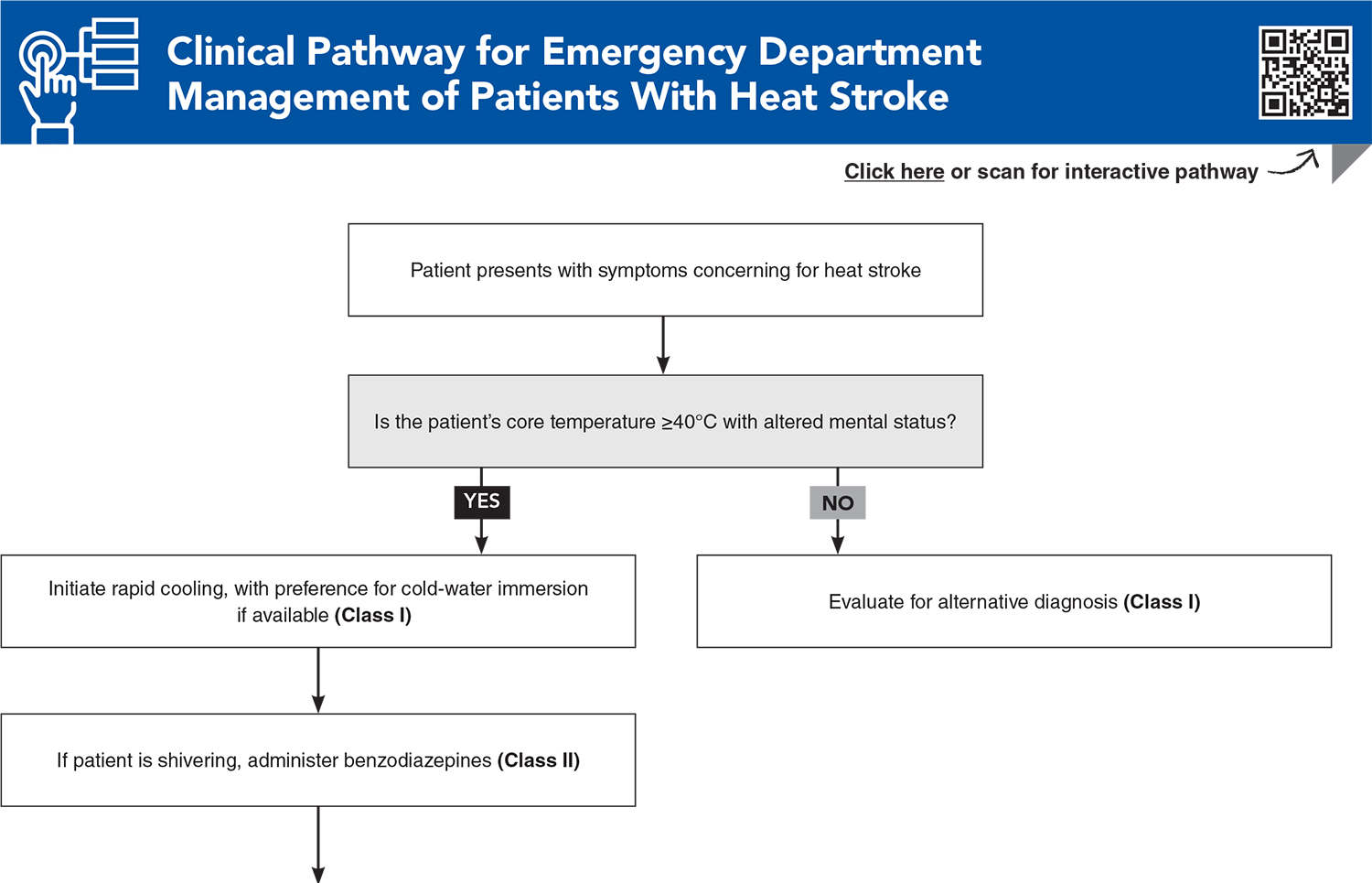
Clinical Pathway for Emergency Department Management of Patients With Heat Stroke

Subscribe to access the complete Clinical Pathway to guide your clinical decision making.

Buy this issue and
CME test to get 4 CME credits.

Key References

Following are the most informative references cited in this paper, as determined by the authors.

4. * Kaewput W, Thongprayoon C, Petnak T, et al. Inpatient burden and mortality of heatstroke in the United States. Int J Clin Pract. 2021;75(4):e13837. (Retrospective cohort study; 3372 patients) DOI: 10.1111/ijcp.13837

8. * Barletta JF, Palmieri TL, Toomey SA, et al. Society of Critical Care Medicine guidelines for the treatment of heat stroke. Crit Care Med. 2025;53(2):e490-e500. (Clinical practice guidelines) DOI: 10.1097/CCM.0000000000006551

9. * Eifling KP, Gaudio FG, Dumke C, et al. Wilderness Medical Society clinical practice guidelines for the prevention and treatment of heat illness: 2024 update. Wilderness Environ Med. 2024;35(1_suppl):112s-127s. (Clinical practice guidelines) DOI: 10.1177/10806032241227924

17. * DeGroot DW, Henderson KN, O’Connor FG. Cooling modality effectiveness and mortality associated with prehospital care of exertional heat stroke casualties. J Emerg Med. 2023;64(2):175-180. (Retrospective study; 462 patients) DOI: 10.1016/j.jemermed.2022.12.015

21. * Epstein Y, Yanovich R. Heatstroke. N Engl J Med. 2019; 380(25):2449-2459. (Review) DOI: 10.1056/NEJMra1810762

23. * Belval LN, Casa DJ, Adams WM, et al. Consensus statement- prehospital care of exertional heat stroke. Prehosp Emerg Care. 2018;22(3):392-397. (Expert consensus statement) DOI: 10.1080/10903127.2017.1392666

25. * Rublee C, Dresser C, Giudice C, et al. Evidence-based heatstroke management in the emergency department. West J Emerg Med. 2021;22(2):186-195. (Review) DOI: 10.5811/westjem.2020.11.49007

28. * Roberts WO, Armstrong LE, Sawka MN, et al. ACSM expert consensus statement on exertional heat illness: recognition, management, and return to activity. Curr Sports Med Rep. 2023;22(4):134-149. (Expert consensus statement) DOI: 10.1249/JSR.0000000000000878

43. * Comp G, Pugsley P, Sklar D, et al. Heat stroke management updates: a description of the development of a novel in-emergency department cold-water immersion protocol and guide for implementation. Ann Emerg Med. 2025;85(1):43-52. (Descriptive study and protocol development report) DOI: 10.1016/j.annemergmed.2024.07.013

62. * Hayashida K, Kondo Y, Hifumi T, et al. A novel early risk assessment tool for detecting clinical outcomes in patients with heat-related illness (J-ERATO score): development and validation in independent cohorts in Japan. PLoS One. 2018;13(5):e0197032. (Prospective study; 3001 patients) DOI: 10.1371/journal.pone.0197032

Subscribe to get the full list of 63 references and see how the authors distilled all of the evidence into a concise, clinically relevant, practical resource.

Keywords: heat stroke, heat-related illness, heat exhaustion, heat cramps, heat syncope, exertional heat stroke, nonexertional heat stroke, classic heat stroke, hyperthermia, thermoregulation, cold-water immersion, rapid cooling, rhabdomyolysis, neuroleptic malignant syndrome, serotonin syndrome, malignant hyperthermia, thyroid storm, J-ERATO score, heat wave, environmental heat illness, EMS heat protocols

Publication Information
Authors

David Fernandez, MD, MHPE; Sophia Gorgens, MD; Carver Goodhue, MD

Publication Date

June 1, 2026

CME Expiration Date

June 1, 2029    CME Information

CME Credits

4 AMA PRA Category 1 Credits™, 4 ACEP Category I Credits, 4 AAFP Prescribed Credits, 4 AOA Category 2-B Credits.

Pub Med ID: 42166611

Get Permission

Content you might be interested in
Get A Sample Issue Of Emergency Medicine Practice
Enter your email to get your copy today! Plus receive updates on EB Medicine every month.
Verification Word:
Enter Verification Word: