
Table of Contents
About This Issue
With the rising prevalence of obesity and the subsequent increase in use of antiobesity medications, urgent care clinicians are more likely to encounter patients with adverse effects from these medications. Commonly prescribed agents, including the popular GLP-1 receptor agonists, can cause symptoms ranging from common gastrointestinal complaints to serious complications such as dehydration, pancreatitis, electrolyte abnormalities, and cardiovascular effects. In addition, patients may not disclose their use of nonprescribed medications, complicating care. This issue of Evidence-Based Urgent Care outlines key strategies for recognizing medication-related symptoms, performing appropriate evaluation, and determining when supportive care versus emergency department referral is needed. In this issue, you will learn:
The medication classes and generic names of the most commonly prescribed weight-loss medications, their mechanism of action, and common and serious adverse effects associated with these medications;
The key history and physical examination elements that are crucial when evaluating patients taking weight-loss medications;
How to distinguish mild side effects from red-flag symptoms requiring diagnostic testing or emergency department referral; and
Evidence-based treatment strategies for common complications, including nausea, dehydration, constipation, and diarrhea.
CODING & CHARTING: Differentiating between an adverse effect or incident of poisoning and other tips are detailed in our monthly coding column.
- About This Issue
- Abstract
- Case Presentations
- Introduction
- Etiology and Pathophysiology
- Differential Diagnosis
- Urgent Care Evaluation
- History
- Physical Examination
- Diagnostic Studies
- Treatment
- Medications
- Dietary Modifications
- Special Populations
- Pediatric Patients
- Older Patients
- Patients With Diabetes
- Patients Undergoing Anesthesia
- Controversies and Cutting Edge
- Shortages
- Off-Label Use
- Cost
- Long-Term Use
- Microdosing
- Link to Euglycemic Ketoacidosis
- Disposition
- Summary
- Critical Appraisal of the Literature
- Time- and Cost-Effective Strategies
- 5 Things That Will Change Your Practice
- Risk Management Pitfalls for Complications of Weight-Loss Medications in Urgent Care
- Case Conclusions
- Coding & Charting: What You Need to Know
- Coding Challenge: Weight-Loss Medication Complications
- Clinical Pathway for Urgent Care Management of Complications in Patients Taking Weight-Loss Medications
- References
Abstract
Given the rising prevalence of obesity and the expanding use of weight-loss treatments, urgent care clinicians must be prepared to recognize and manage potential adverse effects. The most common complaints include nausea, vomiting, diarrhea, and abdominal discomfort, though each medication class carries specific risks and complications. Management strategies vary depending on the medication used and the severity of symptoms. In some cases, discontinuation or dose adjustment may be necessary, while severe complications such as dehydration or pancreatitis may require emergency evaluation. This review provides an overview of the most prescribed weight-loss medications, highlights their potential side effects and complications, and offers evidence-based recommendations for patient management and disposition.
Case Presentations
- The patient has a history of hypertension and obesity.
- His vital signs include: temperature 98.2˚F; heart rate, 92 beats/minute; blood pressure, 108/66 mm Hg; respiratory rate, 16 breaths/minute; oxygen saturation, 99% on room air.
- He denies chest pain, palpitations, shortness of breath, nausea and vomiting, or diarrhea.
- He notes that he is on lisinopril and started semaglutide 3 months ago for weight loss.
- Based on his medication list, you consider what diagnoses are more likely…
- He has a history of type 2 diabetes mellitus and is currently on semaglutide.
- His vital signs are: temperature, 98.9˚F; heart rate, 105 beats/minute; blood pressure, 118/72 mm Hg; respiratory rate, 16 breaths/minute; oxygen saturation, 96% on room air.
- On examination, he has tenderness to palpation of the epigastric area, without rebound tenderness or guarding.
- While attempting to get his symptoms under control with fluids and antiemetics, you consider what workup should be obtained…
- She has a history of obesity and anxiety but no history of hypertension. She denies chest pain, shortness of breath, blurry vision, or neurologic deficits.
- She reports starting phentermine 2 weeks ago for weight loss.
- Vital signs reveal: temperature, 97.9˚F; heart rate, 112 beats/minute; blood pressure, 172/98 mm Hg; respiratory rate, 18 breaths/minute; oxygen saturation, 98% on room air.
- On examination, her heart and lungs are normal, and she has no focal neurologic deficits.
- While attempting to get her symptoms under control with fluids and analgesics, you consider what the cause of her newly elevated blood pressure is...
How would you manage these patients? Subscribe for evidence-based best practices and to discover the outcomes.
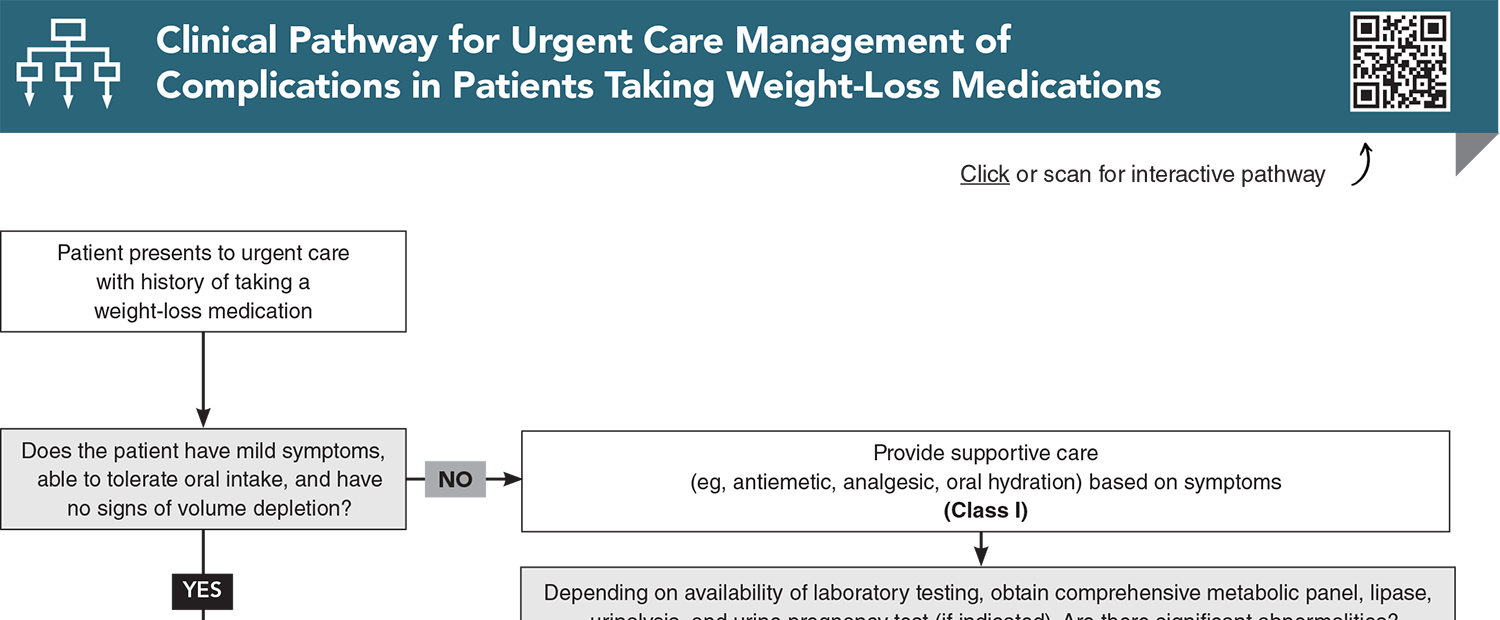
Clinical Pathway for Urgent Care Management of Complications in Patients Taking Weight-Loss Medications
Subscribe to access the complete Clinical Pathway to guide your clinical decision making.
Buy this issue and
CME test to get 4 CME credits.
Key References
Following are the most informative references cited in this paper, as determined by the authors.
2. * Yanovski SZ, Yanovski JA. Approach to obesity treatment in primary care: a review. JAMA Intern Med. 2024;184(7):818-829. (Clinical review) DOI: 10.1001/jamainternmed.2023.8526
3. * DeCleene NK, Kahn E, Yuan CW, et al. US state-level prevalence of adult obesity by race and ethnicity from 1990 to 2022 and forecasted to 2035. JAMA. 2026: e2526817. (Survey data) DOI: 10.1001/jama.2025.26817
4. * Hampl SE, Hassink SG, Skinner AC, et al. Clinical practice guideline for the evaluation and treatment of children and adolescents with obesity. Pediatrics. 2023;151(2):e2022060640. (Practice guideline) DOI: 10.1542/peds.2022-060640 Pharmacotherapy for obesity-trends using a population level national database. Obes Surg. 2021;31(3):1105-1112. (Prospective database study)
6. * Yanovski SZ, Yanovski JA. Long-term drug treatment for obesity: a systematic and clinical review. JAMA. 2014;311(1):74-86. (Clinical review) DOI: 10.1001/jama.2013.281361
7. * Weghuber D, Barrett T, Barrientos-Perez M, et al. Once-weekly semaglutide in adolescents with obesity. N Engl J Med. 2022;387(24):2245-2257. (Randomized controlled trial; 180 participants) DOI: 10.1056/NEJMoa2208601
Subscribe to get the full list of 33 references and see how the authors distilled all of the evidence into a concise, clinically relevant, practical resource.
Keywords: weight-loss medications, glucagon-like peptide-1 (GLP-1) receptor agonist, dual GLP-1/glucose-dependent insulinotropic polypeptide (GIP) receptor agonist, sympathomimetic amine, lipase inhibitor, obesity, drug reactions, semaglutide, liraglutide, tirzepatide, phentermine, phentermine-topiramate, orlistat, naltrexone-bupropion, Xenical®, Qysmia®, Contrave®, Saxenda®, Wegovy®, Zepbound®, gastrointestinal side effects, injection site reactions, constipation, pancreatitis, vomiting, nausea, diarrhea, hyperkalemia, dehydration, renal dysfunction, hypertension, tachycardia, antiobesity medications, oral hydration, antiemetic, analgesia