The Pediatric Urgent Care Playbook
Click to check your cart0
Your Current Course Progress:
0 %

Online CME course for urgent care clinicians

The Pediatric Urgent Care Playbook

Small patients. Big clinical decisions.

A fever. An earache. A child who won’t stop wheezing. You know the complaint—but which findings change the plan? Learn a practical approach to evaluating, treating, and deciding what comes next for children in urgent care, including the can’t-miss signals that call for emergent care.

Explore the 10 modules
5.25 CME creditsSelf-paced online learning
The Pediatric Urgent Care Playbook course cover, powered by PM Pediatric Care
10Focused video modules
5.25CME credits
OnlineLearn at your pace
$299Individual enrollment

The decision behind the complaint

When your patients span all ages, your approach needs to change with them.

A familiar chief complaint is only the starting point. Pediatric care calls for its own approach to the history, examination, treatment, and disposition—with decisions that can shift from routine management to urgent escalation.

Developed by experienced clinicians from PM Pediatric Care, this course gives you a concise, specific game plan for common pediatric presentations. Build your approach around the findings that matter, the treatment options to consider, and the signals that change the next step.

The everyday challenge

You need more than a list of possible diagnoses.

Does this ear infection need antibiotics? Which findings should guide a fever workup? Can this child be managed here, or does the presentation call for a higher level of care?

These are the decisions that make pediatric urgent care demanding—whether you see children every day or as part of a mixed-age patient population.

The playbook approach

A clearer path from presentation to plan.

Connect the history and examination to practical decisions about testing, treatment, observation, and escalation. Each module focuses on a presentation you may encounter in urgent care.

Reinforce what you learn with dedicated workbooks for each module, Knowledge Checks, and clinical pathways, so the reasoning gets as much attention as the answer.

Built around your next clinical decision

What to test. When to treat. When to escalate.

01

Focus the evaluation

Strengthen your approach to the history and examination findings that guide pediatric workups, from fever and ear pain to vomiting, diarrhea, and respiratory symptoms.

02

Make treatment choices with purpose

Review when to test, when to treat, and how patient factors shape the plan—including antibiotic selection, pediatric dosing considerations, and treatment alternatives.

03

Recognize when the plan must change

Build your ability to identify high-risk presentations and determine when observation, further evaluation, or escalation of care is needed.

Designed for the way you learn

Build your playbook one presentation at a time

Begin with a common complaint you encounter in practice or a clinical decision you want to feel more confident making. Move through the course at your own pace, save your progress, and return exactly where you left off. Focused modules and resources for every lesson make it easy to learn in manageable sessions.

  • See how pediatric experts make the call. Learn from pediatric urgent care clinicians who teach the evaluation and management decisions behind each pediatric presentation.
  • Put your reasoning to work. Use module workbooks with summaries, key tables, Knowledge Checks, answer keys, and space for your own notes.
  • Choose the format that works. Review with audio-only downloads and transcripts, plus interactive clinical pathways in selected modules.

Ten presentations. Real decisions you make on shift.

Explore the course modules

01Anaphylaxis14 minutes  |  0.5 CME credits

Recognize the reaction. Plan the next step.

  • Recognize signs and symptoms of pediatric anaphylaxis.
  • Review pediatric epinephrine dosing and the role of adjunctive medications.
  • Distinguish patients appropriate for observation and discharge from those who need escalation of care.
02Closed Head Injuries32 minutes  |  0.5 CME credits

Bring pediatric risk into focus.

  • Understand the anatomical and physiological differences that affect pediatric head injury assessment.
  • Apply risk stratification to decisions about imaging, transfer, discharge, and in-office observation.
03Ear Pain32 minutes  |  0.5 CME credits

Make a clearer treatment decision.

  • Use the history and examination to distinguish acute otitis media from otitis externa.
  • Recognize when immediate antibiotics or watchful waiting is appropriate.
  • Review first-line antibiotics, alternatives for allergy or treatment failure, and dose and duration.
04Pediatric Fever35 minutes  |  0.5 CME credits

Look beyond the temperature.

  • Identify the history and examination findings that guide the pediatric fever workup.
  • Recognize when blood testing, urinalysis, and other screening measures are indicated.
  • Review evidence-based first-line antibiotics for pediatric urinary tract infections.
05Respiratory Conditions47 minutes  |  1 CME credit

Know which findings change the plan.

  • Differentiate common pediatric respiratory infections using the history and physical examination.
  • Recognize potentially dangerous presentations that require escalation of care.
  • Apply evidence-based treatment protocols for pediatric respiratory infections.
06Sepsis13:33 minutes  |  0.25 CME credits

Recognize when a common presentation needs urgent action.

  • Differentiate early pediatric sepsis from common viral illnesses.
  • Determine which febrile patients require immediate intervention and transfer.
  • Apply a pediatric sepsis pathway to identification, initial stabilization, and transfer.
07Skin and Soft Tissue Infections28 minutes  |  0.5 CME credits

Match the presentation to the right intervention.

  • Distinguish cellulitis, impetigo, paronychia, and abscess from other pediatric skin conditions.
  • Recognize when to suspect MRSA or other resistant pathogens.
  • Identify indications for incision and drainage and select antibiotic therapy based on patient factors, allergies, and evidence.
08Throat Pain32 minutes  |  0.5 CME credits

Clarify when to test, treat, or escalate.

  • Use the history and examination to distinguish viral from bacterial pharyngitis and guide testing for group A streptococcal infection.
  • Recognize dangerous throat infections that require escalation of care.
  • Review antibiotic selection, dose, and duration, including allergy, treatment failure, and strep carriers.
09Vomiting and Diarrhea28 minutes  |  0.5 CME credits

Assess severity with a pediatric lens.

  • Distinguish clinical features of serious illness from self-limiting conditions.
  • Evaluate dehydration and determine the appropriate level of intervention.
10Wheezing19 minutes  |  0.5 CME credits

Connect severity with treatment and disposition.

  • Review common presentations and differential diagnoses of pediatric wheezing.
  • Apply respiratory scoring systems to assess bronchiolitis and asthma severity.
  • Select first-line treatment and disposition for pediatric patients with wheezing.

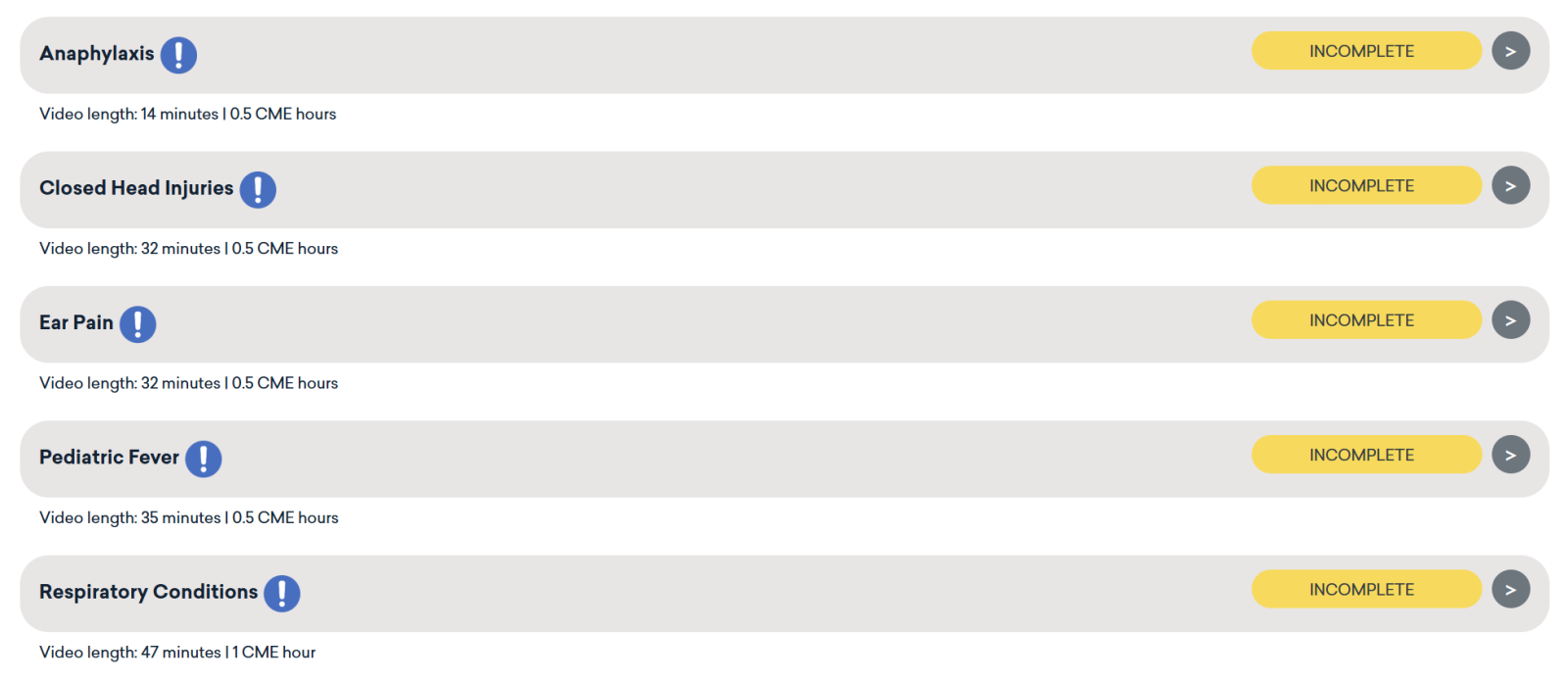
Sample course progress page

Sample course dashboard showing Anaphylaxis, Closed Head Injuries, Ear Pain, Pediatric Fever, and Respiratory Conditions with video lengths and CME credit amounts

Choose how you learn best

More than one way to learn and review

Each format gives you another way to engage with the material—from your first lesson to your next review.

Focused video instruction

Ten high-yield video modules developed by experienced pediatric urgent care clinicians.

A workbook for every topic

Summaries, key tables, and space for notetaking help you organize what you want to remember.

Knowledge Checks

Questions and answer keys in the workbooks help you assess your understanding and identify topics to revisit.

Interactive clinical pathways

Selected modules include interactive pathways to reinforce a structured approach to clinical decisions.

Audio and transcripts

Every module includes an audio file and transcript, giving you flexible ways to review beyond the video.

CME by module

Complete the CME test for each module, with a total of 5.25 CME credits across the course.

Make pediatric preparedness part of your practice

Be better prepared for the next child through your door.

Build a more deliberate approach to the presentations that bring children into urgent care. Get the full course, learn at your pace, and use the workbooks and review formats to make each lesson count.

Pediatric expertise. Urgent care perspective.

Learn from clinicians
who know these decisions firsthand

Faculty from PM Pediatric Care bring experience in pediatric emergency medicine, urgent care, and medical education to a course built around practical clinical reasoning for your pediatric patients.

Nikhil Shah, MD

More than 25 years of experience in pediatric emergency medicine and urgent care, with leadership in research, simulation, and fellowship education.

Read full bio

Nikhil Shah, MD, is the Research Director for the Division of Pediatric Emergency Medicine and Director of the Simulation Program for the Department of Pediatrics at NewYork-Presbyterian/Weill Cornell Medical Center, where he formerly served as Director of the Fellowship Training Program in Pediatric Emergency Medicine. Dr. Shah has spoken and taught at regional and national conferences, including leading the pediatric track at the Urgent Care Association’s annual convention. He is published in peer-reviewed journals and has authored numerous review articles and textbook chapters.

Eric Weinberg, MD

More than 20 years of experience in pediatric emergency medicine and urgent care.

Read full bio

Eric Weinberg, MD, completed his pediatric residency and fellowship training in pediatric emergency medicine at NYU Langone Health and Bellevue Hospital Center. He has served as Director of the Pediatric Emergency Simulation Program at NewYork-Presbyterian/Weill Cornell Medical Center and at Maria Fareri Children’s Hospital. Dr. Weinberg has presented at regional and national conferences and published in peer-reviewed journals.

Accredited continuing medical education

CME and accreditation

Build your pediatric urgent care knowledge while earning CME credit, with a test available for each module.

5.25AMA PRA Category 1 Credits™
5.25AOA Category 2-B credit hours

Everything you need to know

Questions before enrolling?

Find quick answers about access, flexibility, included formats, and group enrollment.

Who is this course for?

The course is designed for clinicians who care for children in urgent care. Clinicians in emergency and primary care settings may also find the focus on common pediatric presentations relevant to their practice.

How long will I have access?

You’ll have lifetime access to the course, so you can return to the lessons and resources whenever you need a refresher.

Can I stop and return later?

Yes. Your progress is saved, allowing you to stop at any point and resume where you left off.

What comes with each module?

Each module includes a video, workbook, audio file, transcript, and CME test. Workbooks include summaries, key tables, clinical pathways, Knowledge Check questions and answer keys, and space for notes. Interactive clinical pathways are also available in selected modules.

How many CME credits can I earn?

The 10 modules offer a total of 5.25 CME credits. Credit amounts vary by module, and each module has its own CME test. See the CME and accreditation section for the credit designation statements.

Can I purchase access for my team?

Yes. Inquire about special group pricing for clinicians at your urgent care group or organization.

Your next chapter in pediatric confidence starts here

Bring a pediatric playbook
to your next shift.

Need access for a group?

The Pediatric Urgent Care Playbook

Price: $299.00

Money-back guarantee