Home > All Topics > Inside Guide to X-Ray Interpretation
Your Current Course Progress:
Online CME course for urgent care clinicians
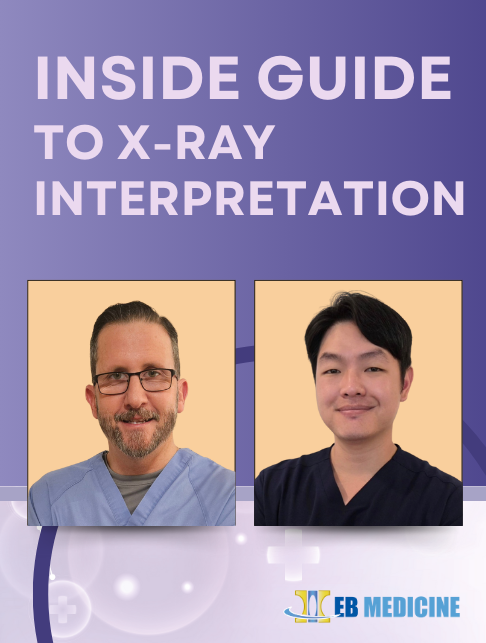
Inside Guide to X-Ray Interpretation
A Systematic Approach for Reading Radiographs in Urgent Care
This course provides a proven-successful game plan for interpreting plain films, distinguishing routine features from high-risk findings, and avoiding common pitfalls that lead to missed diagnoses in urgent care. It combines fast-track anatomy lessons with step-by-step instructions to teach technique, and concludes with multiple real-life case study challenges to reinforce it all—so you can read more confidently, act more decisively, and reduce the risk of missed findings on every shift.
When the initial read is yours,
a reliable process matters
This course was developed by leaders of one of the nation’s largest urgent care systems to cover this training topic in context of the day-to-day realities in their clinics, where X-ray is the primary, if not the only, diagnostic imaging mode.
Having a systematic approach—a reliable method to correlate physical exam findings with what you’re seeing on film, brings order, focus, and accuracy to your preliminary interpretations. Inside Guide to X-Ray Interpretation teaches you how to approach every radiograph the same way every time.
The common gap
Exposure without a consistent method
Because you don’t have a full-time radiologist on site, the responsibility for initial interpretation rests with you. Many clinicians entering urgent care were never trained for high-volume injury evaluation or rapid image interpretation.
Most clinicians can spot a broken bone, dislocated joint, or a pleural effusion on plain films. But many never received training on some of the more subtle signs visible on X-rays. For example, how many would recognize the “pooping duck” sign if you saw it? What about the “spilled teacup” or the “sail” sign?
The course approach
A framework to use every time
You’ll learn how to check for the right exposure and the adequacy of angles. You’ll study degrees of density associated with anatomical features and the vocabulary of various views. You’ll be able to trace borders and margins based on contrast.
What’s next? You’ll take a structured, in-depth journey through radiograph interpretation, from A to Z!
Built for immediate clinical impact
How this course will change your practice
01
Use a repeatable method
Even under pressure, you can rely on a mental checklist—the systematic approach—which leads to stronger clinical reasoning.
02
Recognize subtle findings
Learn to spot it all, from the clear and obvious signs to the subtle and occult. And you'll know how to diagnose and create a treatment plan with confidence. At the clinic and system level, subtle findings are less likely to be overlooked.
03
Make clearer, more confident decisions
Clinical confidence is the natural byproduct of this practical, relevant training that promises immediate impact. Over time, your confidence and consistency will strengthen documentation, support more defensible clinical decisions, and improve patient safety records.
Designed for the way you learn
Built to fit around clinical schedules
Move through the course at your own pace, save your progress, and return exactly where you left off. Choose the format that fits your schedule—video, audio, transcripts, workbook activities, or case-based review.
Learn in focused sessions. Work through engaging, high-yield video modules developed by experienced urgent care clinicians.
Return without starting over. Your progress is saved, so you can pause and resume whenever your schedule allows.
Choose the format that works. Reinforce each lesson with audio-only downloads, transcripts, an interactive workbook, and CME testing for every module.
From fundamentals to real-world application
Explore the course modules
01Foundations1 module+
Module 1: Getting Started With X-Rays
02Chest X-Rays3 modules+
Module 2: Chest X-Ray Essentials
Module 3: Chest X-Ray Anatomy & Pathology
Module 4: Chest X-Ray Case Studies (Pneumonia, Pneumothorax, Atelectasis, and Pulmonary Edema)
03Musculoskeletal X-Rays8 modules+
Module 5: Musculoskeletal X-Ray Essentials
Module 6: Wrist
Module 7: Elbow
Module 8: Foot
Module 9: Ankle
Module 10: Hip, Knee, & Fibula
Module 11: Hand
Module 12: Shoulder
04Abdominal X-Rays1 module+
Module 13: Abdominal X-Ray Essentials
Choose how you learn best
More than one way to learn and review
▶
Video modules
Engaging, high-yield instruction developed by experienced urgent care clinicians—not radiologists.
✓
Frameworks and checklists
Structured tools for reading chest and musculoskeletal X-rays.
Real-world cases
Case examples that highlight subtle, high-stakes findings.
✎
Interactive workbook
Downloadable summaries, key images, action items, clinical pearls, and space for notetaking.
♪
Audio and transcripts
Audio-only downloads and complete transcripts for flexible review.
CME by module
CME tests and credit hours are available for each module.
The proof is in the practice
What clinicians say about the course
Here’s what your peers have to say about Inside Guide to X-Ray Interpretation.
“
This course made me a more systematic and confident x-ray interpreter. I now assess image quality first, follow a consistent approach across musculoskeletal and chest films, and look more carefully for subtle or occult injuries that could easily be missed. It reinforced how to connect radiographic findings with the history and physical exam, recognize unstable injuries, and make better decisions about immobilization, follow-up, and urgent referral.
Mark J. Cha, NPMidwest Express Urgent Care
“
I feel much more confident evaluating lung pathology on x-rays.
Catherine Peterson, NP
“
This course taught me to review x-rays systematically, helping me avoid errors.
Ajani Millsap, NPGoHealth Urgent Care
Turn learning into clinical action
Put a systematic approach into practice
Enroll today to build a repeatable radiograph interpretation process you can use on your very next shift—with flexible access to every lesson, case, and learning resource.
Expertise grounded in urgent care
Learn from urgent care leaders
The faculty bring frontline clinical, educational, and operational leadership from one of the nation’s largest urgent care systems, grounding every lesson in the decisions clinicians make on shift.
Michael Kim, DO, FCUCM
Clinical educator, urgent care fellowship director, and Assistant Professor of Family Medicine
Read full bio
Dr. Michael Kim is a board-certified family medicine physician and Fellow of the College of Urgent Care Medicine. He serves as Clinical Manager of Education and Training and previously held the role of Associate Medical Director at Northwell GoHealth Urgent Care, where he focused on advancing clinical excellence across urgent care teams. Dr. Kim is also the Director of the Urgent Care Association–accredited Urgent Care Fellowship Program. In 2024, he received the Rising Star Award in recognition of emerging leadership in urgent care medicine. He serves as a GME rotation director for family medicine residency, physician assistant, and nurse practitioner programs and is an Assistant Professor of Family Medicine at the Donald and Barbara Zucker School of Medicine at Hofstra Northwell.
Kevin Reiter, MD, FCUCM
Urgent care medical director and Assistant Professor of Family Medicine
Read full bio
Dr. Kevin Reiter is a board-certified family medicine physician and Fellow of the College of Urgent Care Medicine. He serves as Medical Director for GoHealth Urgent Care, providing clinical and operational oversight across the organization’s urgent care centers. Dr. Reiter is an Assistant Professor of Family Medicine at the Donald and Barbara Zucker School of Medicine at Hofstra Northwell. He received the Sean M. McNeeley Award for Advancing the Specialty in recognition of his contributions to urgent care medicine. Prior to medical school, he practiced as a physician assistant in orthopedics, family medicine, emergency department fast-track, and urgent care settings, informing his practical, real-world approach to urgent care education.
Accredited continuing medical education
CME and accreditation
Earn credit while strengthening the X-ray interpretation skills you use in urgent care practice.
6AMA PRA Category 1 Credits™6AOA Category 2-B credit hours
Accreditation: EB Medicine is accredited by the Accreditation Council for Continuing Medical Education (ACCME) to provide continuing medical education for physicians.
AMA Credit Designation: EB Medicine designates this internet enduring material for a maximum of 6 AMA PRA Category 1 Credits™. Physicians should claim only the credit commensurate with the extent of their participation in the activity.
AOA Credit Designation:Inside Guide to X-Ray Interpretation is eligible for 6 Category 2-B credit hours by the American Osteopathic Association.
Everything you need to know
Questions before enrolling?
Find quick answers about access, flexibility, included formats, and group enrollment.
How long will I have access? +
You’ll have lifetime access to the course, so you can return to the lessons and resources whenever you need a refresher.
Can I stop and return later? +
Yes. Your progress is saved, allowing you to stop at any point and resume where you left off.
What learning formats are included? +
The course includes video modules, structured frameworks and checklists, real-world cases, a downloadable interactive workbook, audio-only downloads, transcripts, and CME tests for each module.
Is group pricing available? +
Yes. Special pricing is available for urgent care groups and organizations.
 678-366-7933


 Product Library