| TOPICS | | CME CREDITS |
PUBLICATION DATE |
Jump to relevant content: Urgent Care Evaluation … angioedema based on various criteria. Ishoo et al performed a single-center retrospective chart review of 80 adult patients with 93 episodes of angioedema over an 11-year period who presented to the… Treatment … angioedema is not allergic in nature, standard treatments such as epinephrine and antihistamines will be ineffective. Typically, C1-inhibitors, bradykinin B2 receptor antagonists, and kallikrein inhibitors are used for treatment of bradykinin-mediated… Risk Management Pitfalls in Management of Angioedema in Urgent Care … angioedema.” All causes of angioedema should be considered when initiating treatment, but allergic and immunologic reactions very frequently cause angioedema. Epinephrine should be considered as a therapeutic option, along with antihistamines,… | 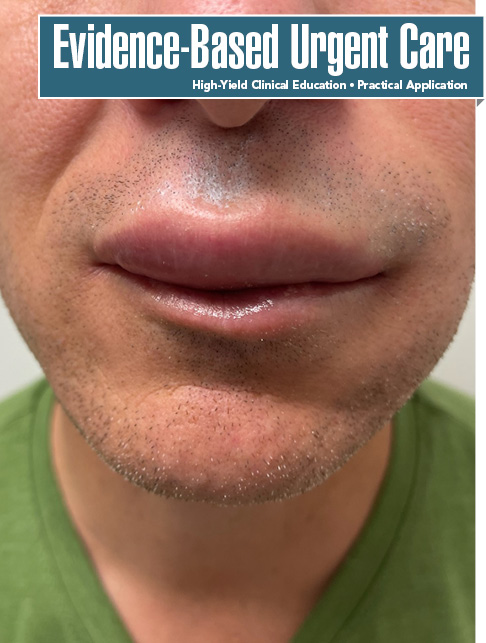 | Credits: 4 |
Publication Date: May 2024 |
Get access to this evidence-based, clinically relevant content:
Buy now to continue reading. Or
Jump to relevant content: Emergency Department Evaluation … angioedema might have different symptoms, generally, most cases involve the face, extremities, and/or gastrointestinal tract. In some studies of HAE, the rates of gastrointestinal involvement might be as high as 73%,… Treatment … angioedema. 62 When compared to a corticosteroid and antihistamine combination therapy in ACEI-induced angioedema, icatibant was found to have a shorter median time to complete resolution of ACEI-induced angioedema (8 hours… Risk Management Pitfalls in Managing Angioedema in the Emergency Department … angioedema.” All causes of angioedema should be considered when initiating treatment, but allergic and immunologic reactions very frequently cause angioedema. Epinephrine should be considered as a therapeutic option, along with antihistamines and… |  | Credits: N/A |
Publication Date: Oct 2022 |
|  | Credits: N/A |
Publication Date: N/A |
Get access to this evidence-based, clinically relevant content:
Buy now to continue reading. Or
Jump to relevant content: Risk Management Pitfalls In Management Of Allergy And Anaphylaxis … angioedema that may not be responsive to epinephrine and standard treatments. Airway management and fresh-frozen plasma may be indicated, and immediate cessation of the ACE-inhibitor is always necessary. Most ACE-inhibitor reactions… Differential Diagnosis … angioedema (ACEIIA) can occur at any time in the treatment course in 0.1% to 0.7% of patients, although the majority of cases occur in the first weeks after starting the medication. Controversies And Cutting Edge … angioedema in December 2009, a multicenter, double-blinded, randomized, controlled phase 2 trial was undertaken to determine its effectiveness in ACEIIA. However, results published in August 2014 did not show a significant… |  | Credits: N/A |
Publication Date: Aug 2015 |
|  | Credits: N/A |
Publication Date: N/A |
Get access to this evidence-based, clinically relevant content:
Buy now to continue reading. Or
Jump to relevant content: Intravenous Thrombolysis Complications … angioedema occurs in 1% to 5% of patients after receiving IVT. 46-48 Most of the cases are mild and self-limited. The airway should always be assessed and prophylactic intubation considered because,… |  | Credits: N/A |
Publication Date: Jun 2019 |
Get access to this evidence-based, clinically relevant content:
Buy now to continue reading. Or
Jump to relevant content: Emergency Department Evaluation … angioedema. 46,56 A minority of patients lack cutaneous manifestations. 37,38,46,56,66 Patients may present with predominantly gastrointestinal or neurologic symptoms (eg, syncope or dizziness due to hypotension). For patients who are unable… Treatment … angioedema, and beta-adrenergic effects of epinephrine treat associated bronchospasm. 18 In addition to the immediate cardiorespiratory effects, epinephrine is thought to decrease further release of inflammatory mediators from basophils and mast… Differential Diagnosis … angioedema should be considered for patients with lip and tongue swelling. Various causes of shock should be considered for patients with hypotension. The differential diagnosis of urticaria is broad. One unusual… |  | Credits: N/A |
Publication Date: Jun 2019 |
Get access to this evidence-based, clinically relevant content:
Buy now to continue reading. Or
Jump to relevant content: Treatment … angioedema) can be treated with a 3- to 5-day burst of oral corticosteroids, which may reduce the duration and severity of symptoms. 33 Corticosteroids do have significant side effects, so these… Pathophysiology and Epidemiology … angioedema (from increased vascular permeability), gastrointestinal symptoms, and hemodynamic changes. 1,4,14 As illustrated in Table 3 and Table 4, there is a continuum of allergic reaction symptoms ranging from a mild… |  | Credits: N/A |
Publication Date: Jul 2022 |
Get access to this evidence-based, clinically relevant content:
Buy now to continue reading. Or
Jump to relevant content: Venomous Lizards … angioedema. Patients with angioedema should be intubated if there is concern for airway compromise. |  | Credits: N/A |
Publication Date: Sep 2021 |
Get access to this evidence-based, clinically relevant content:
Buy now to continue reading. Or
Jump to relevant content: Etiology and Pathophysiology … angioedema, infections (eg, Ludwig angina or retropharyngeal abscess), trauma, malignancy, or foreign body. The presentation of a patient in respiratory distress where there is evidence of upper airway obstruction, such as… |  | Credits: N/A |
Publication Date: Nov 2022 |







 678-366-7933


 Product Library