Safeguarding Charting: Documentation Support That Will Stand Up in Court
Click to check your cart0
Your Current Course Progress:
0 %

Online CME Course for Urgent Care Clinicians

Safeguarding Charting:
Documentation Support That Will Stand Up in Court

Would your chart tell the same story you would in court?

Learn to capture the clinical reasoning and critical details that support a more defensible record.

You considered the dangerous diagnoses, evaluated the red flags, and explained when to seek further care. But if someone reviewed your chart months later, would they see the reasoning behind your decisions?

Learn to close that gap with guidance from an urgent care physician and a medical-legal consultant. Five video modules, ten urgent care case reports, and practical documentation tools help you create clearer, more defensible records—from the initial history to the discharge plan.

Explore the 5 modules
  • 4 CME credits
  • Unlimited, lifetime course access
  • Workbook and practical charting tools
Safeguarding Charting: Documentation Support That Will Stand Up in Court course cover
5Video modules
10Urgent care case reports
4CME credits
LifetimeUnlimited course access

Your clinical judgment deserves a clear record

When your care is reviewed,
your chart needs to tell the story.

A diagnosis and a treatment plan do not explain everything you considered. Unaddressed abnormal findings, conflicting notes, or a vague discharge plan can leave important questions about an encounter—even when you remember providing thoughtful care.

Safeguarding Charting helps you recognize those gaps and document the clinical reasoning behind your care. Learn what makes a record more complete, how charting can affect a malpractice claim, and which habits you can strengthen on your next shift to better support your defense if your care is challenged.

The common gap

The care you provided is not always the care your chart conveys.

You may ask the right questions and consider serious alternatives, yet leave the reasoning out of your note. Templates and smart phrases can help you work efficiently, but they can also carry forward omissions or create inconsistencies that deserve a closer look so you can better protect your practice.

The challenge is knowing which details matter—and making them visible in the record you create.

The course approach

See your chart through a clinician’s and a reviewer’s eyes.

Dr. Tracey Quail Davidoff and Dr. Jeff Willis connect everyday urgent care encounters with the questions that arise when documentation is scrutinized. Learn how to explain your medical decision making, address discrepancies, and document follow-up and return precautions.

Then see those principles applied across ten common chief complaints, with case discussions that connect the presentation, red flags, clinical reasoning, and discharge instructions.

Built for your next shift

How this course will change your practice

Give your medical decision making a stronger defense.

Document the findings and clinical reasoning that support your assessment and plan. Help the next person reviewing the chart understand what you considered and why you chose that course of care.

Recognize the gaps that invite questions.

Identify vague descriptions, unresolved discrepancies, and abnormal findings that need explanation. Examine the benefits and pitfalls of templates, smart phrases, and clinical decision rules.

Give the discharge plan the detail it deserves.

Strengthen documentation of patient discussions, follow-up, and return precautions. Use complaint-specific examples to see how discharge instructions connect to the risks considered during the encounter.

Designed for the way you learn

Learn what matters. See it in a case. Bring it to your next chart.

The course moves from the foundations of medical malpractice to practical charting skills, then reinforces those skills through common urgent care cases. Follow the instructors’ reasoning and use the workbook to put the lessons into practice.

  • Understand why documentation comes under scrutiny. Learn the four elements of malpractice and how the clinical record factors into evaluating a claim.
  • Practice spotting what is missing. Work through charting exercises involving histories, physical examinations, discrepancies, and shared decision making.
  • Return when you need a refresher. Unlimited, lifetime access lets you replay case discussions and revisit the course materials as you put the lessons into practice.

From legal foundations to everyday encounters

Explore the course modules

Five modules connect malpractice risk, clear clinical reasoning, and practical documentation. Learn at your own pace and replay any lesson.

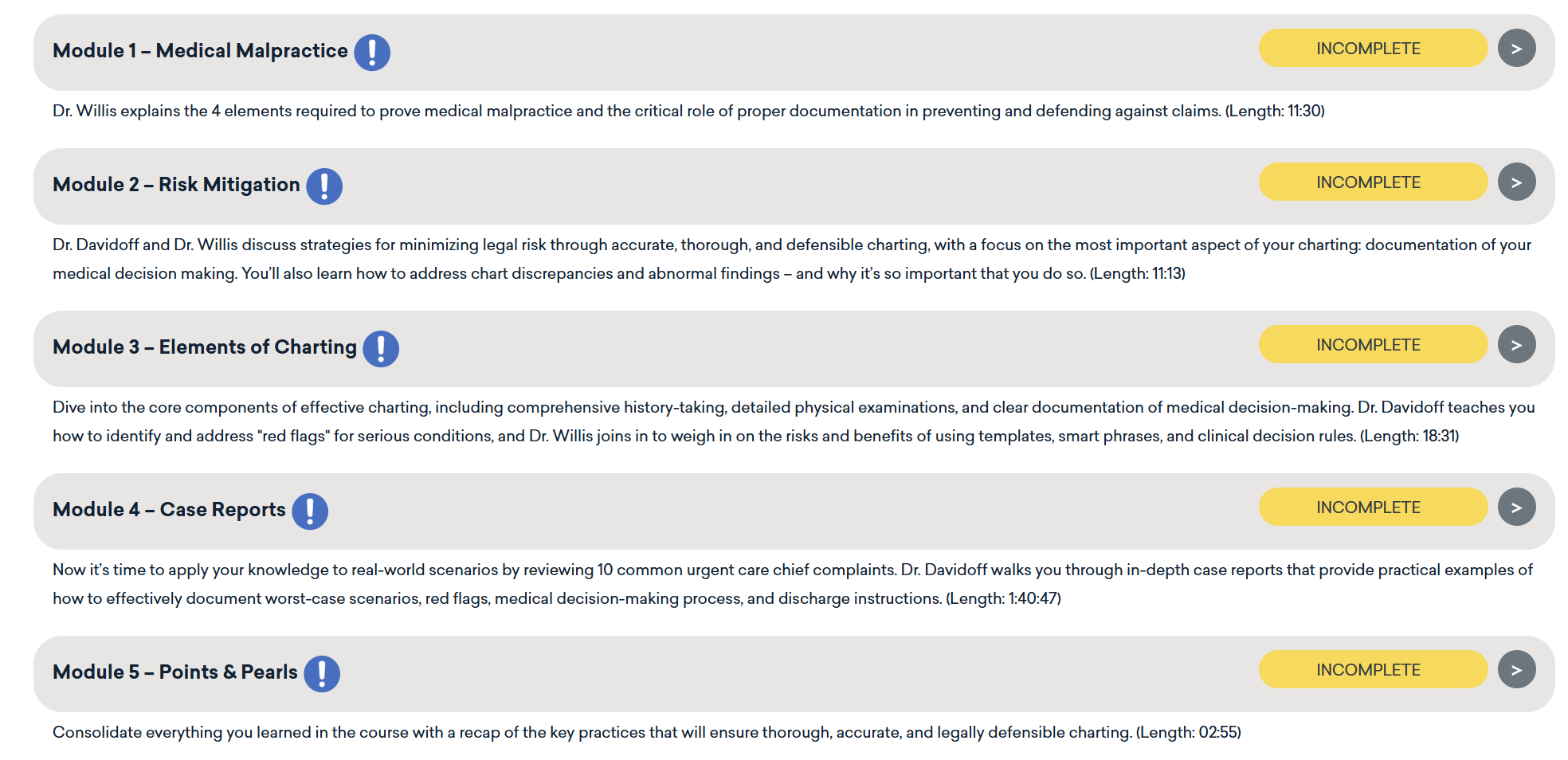
01Medical Malpractice

Understand the four elements required to prove malpractice and why documentation matters when the care you provided is reviewed. Dr. Willis introduces the medical-legal perspective that grounds the rest of the course.

02Risk Mitigation

Learn how accurate, thorough charting communicates your medical decision making. Dr. Davidoff and Dr. Willis discuss how to address discrepancies and abnormal findings so important parts of the encounter do not go unexplained.

03Elements of Charting

Strengthen the history, physical examination, and documentation of your reasoning. Explore red flags, shared decision making, and discharge documentation, along with the risks and benefits of templates, smart phrases, and clinical decision rules.

04Case Reports10 chief complaints

See the principles applied to the complaints you encounter in urgent care. Dr. Davidoff walks through serious diagnostic possibilities, red flags, medical decision making, and discharge instructions, with practical examples of what to consider and document.

  • Chest pain
  • Back pain
  • Abdominal pain
  • Sore throat
  • Headache
  • Vomiting and diarrhea
  • Skin and soft-tissue infections
  • Dysuria
  • Shortness of breath
  • Dizziness
05Points & Pearls

Consolidate the lessons with a focused recap of the key practices that support thorough, accurate, and more defensible charting. Return to this summary as you build stronger documentation habits.

Preview the course experience
Safeguarding Charting course module preview showing Medical Malpractice, Risk Mitigation, Elements of Charting, Case Reports, and Points and Pearls

Choose how you learn best

Watch, listen, practice, and revisit.

Expert-led video modules

Five lessons with clinical and medical-legal perspectives, ready to pause, replay, and complete at your own pace.

Ten case reports

Reinforce your charting skills through ten urgent care case reports that connect red flags, clinical reasoning, and discharge planning with what belongs in the record.

Printable, fillable workbook

Guided exercises, case worksheets, and space to practice applying the lessons to the record you create.

Charting tools and templates

A chart checklist, discharge instruction template, and clinical decision rule resources to revisit as needed.

Audio-only downloads

Listen to the instruction when audio fits your day, including during your commute.

Searchable transcripts

Find a concept from the instructional voiceovers and return to the guidance you want to review.

The proof is in the practice

What clinicians say about the course

Safeguarding Charting is very well written, with great case studies and real-life scenarios that help the learner understand and appreciate how malpractice can arise in many different scenarios.

Elizabeth Hall, FNP

I will be more mindful of medical decision making, red flags, and discharge instructions. The case reports were also very helpful in showing what to look for and document during the physical exam.

Amy Hartman, APP

Safeguarding Charting is a great course, with good guidance on documenting your reasoning and including shared decision making.

Kim Clark, NP

Stronger documentation starts with your next chart

Build a stronger record
to protect your practice.

For $199, get practical instruction in the details that make your clinical reasoning clear. Work through five modules and ten case reports, then keep returning to the videos, workbook, and charting tools with unlimited, lifetime course access.

Clinical experience meets medical-legal insight

Learn from physicians who know how charts are used—and reviewed.

Dr. Davidoff brings experience in urgent care, emergency medicine, case review, and expert witness work. Dr. Willis brings an emergency medicine background and a medical-legal consulting perspective informed by work with both plaintiff and defense attorneys.

Tracey Quail Davidoff, MD, FACP, FCUCM

Tracey Quail Davidoff, MD, FACP, FCUCM

Urgent care physician, course director, and instructor

Read full bio

Dr. Davidoff has practiced urgent care medicine for more than 15 years following 15 years as an emergency physician. Her experience includes case review for the New York State Department of Health Office of Professional Misconduct and expert witness work for legal firms throughout the United States. She has lectured extensively on emergency medicine and urgent care and serves as Editor-in-Chief of EB Medicine’s Evidence-Based Urgent Care.

Jeff Willis, MD

Jeff Willis, MD

Emergency physician, medical-legal consultant, and instructor

Read full bio

Dr. Willis has more than 20 years of clinical experience in emergency departments of all sizes. He holds a master’s degree in healthcare administration and has served in hospital leadership roles, including medical director of a Level I trauma center. His medical-legal consulting work helps plaintiff and defense malpractice attorneys understand the strengths and weaknesses of their cases, with a focus on prelitigation and pretrial services.

Accredited continuing medical education

CME and accreditation

Earn credit while strengthening your approach to urgent care documentation and medical decision making.

4AMA PRA Category 1 Credits™
4AOA Category 2-B credit hours

Everything you need to know

Questions before enrolling?

Quick answers about the course, included materials, access, and CME.

Who is this course for?

Physicians, PAs, NPs, and other urgent care clinicians who want to reduce documentation-related legal risk and create records that better support their defense if their care is challenged. Learn to recognize charting pitfalls, explain your clinical reasoning, and document the details that matter when an encounter comes under scrutiny.

I already document carefully. What can I gain?

The course helps you examine whether your chart communicates the care and reasoning behind it. Case discussions and workbook exercises offer a way to identify omissions, address inconsistencies, and strengthen documentation of red flags, shared decision making, and discharge planning.

What is included in the $199 enrollment?

Unlimited, lifetime access to all five video modules and included course materials: ten case reports, a printable and fillable workbook, audio-only downloads, and searchable transcripts. The workbook includes charting exercises, case worksheets, Points & Pearls, a knowledge check, a chart checklist, a discharge instruction template, and clinical decision rule resources. Enrollment also includes the opportunity to earn up to 4 CME credits.

How long does the course take?

The five video modules total approximately two and a half hours. The course is fully self-paced, so you can split it into sessions and allow additional time for workbook exercises and the CME test.

How long will I have access?

Your course access is unlimited and for life. Return to the videos and included materials whenever you want to review a concept or reinforce a documentation habit.

Does the course include CME?

Yes. Earn up to 4 AMA PRA Category 1 Credits™. The course is also eligible for 4 AOA Category 2-B credit hours. CME credit must be earned before February 1, 2028; your unlimited, lifetime course access continues beyond that date.

Is group pricing available?

Yes. Contact EB Medicine about group pricing for your clinicians or urgent care organization.

Clear reasoning. Stronger records.

Make your next chart a clearer account of your clinical judgment.

Safeguarding Charting: Documentation Support That Will Stand Up in Court

Price: $199.00

Money-back guarantee

Get A Sample Issue Of Emergency Medicine Practice
Enter your email to get your copy today! Plus receive updates on EB Medicine every month.
Verification Word:
Enter Verification Word: