EB Medicine • Urgent Care Clinical Performance Index™
Know where your clinicians are ready—and where they need support.
Chest pain. Dizziness. Abdominal discomfort. Familiar complaints can carry unfamiliar risks. The Urgent Care Clinical Performance Index™ is an evidence-informed assessment of how clinicians recognize risk, make treatment decisions, and plan next steps in urgent care.
A focused assessment—not a traditional course. Results help identify educational priorities.
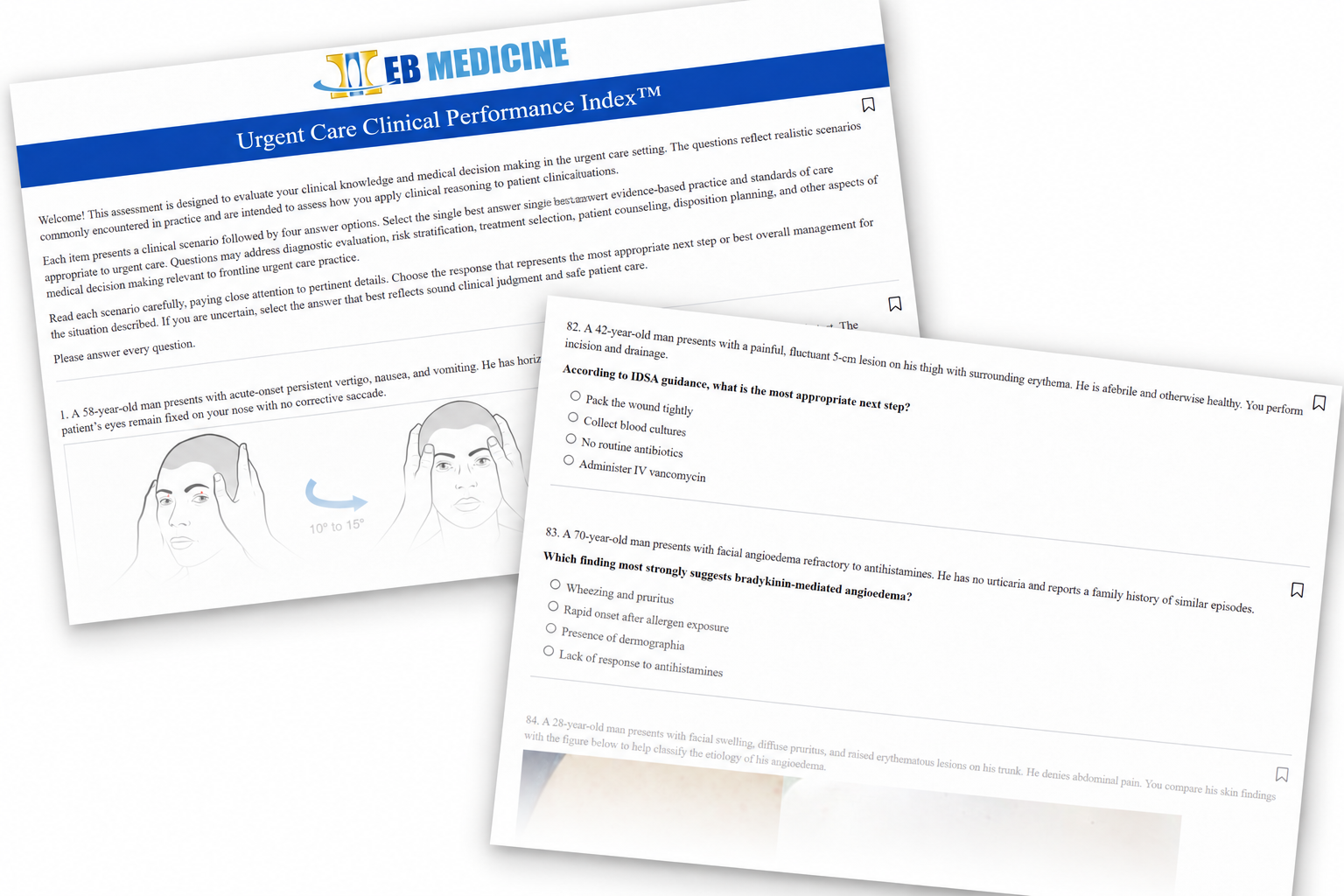
Assessment preview • Representative pages
A clearer picture of clinical readiness
Evaluate the decisions behind patient care.
A résumé, interview, or orientation tells only part of the story. The CPI goes beyond knowledge recall to explore how clinicians apply judgment in real-world urgent care situations.
Recognize what cannot be missed
Identify concerning findings, distinguish high-risk presentations, and make appropriate escalation decisions.
Choose appropriate care
Evaluate clinical reasoning around treatment, diagnostic testing, guideline adherence, and stewardship.
Make sound next-step decisions
Examine disposition, transfer, follow-up, procedural judgment, documentation, and safety-netting.
Built specifically for urgent care
Real presentations. High-stakes judgment. Practical insights.
Urgent care clinicians manage a broad range of conditions, often with limited follow-up and limited on-site support. The CPI reflects those day-to-day and high-risk decisions.
Common urgent care presentations
Respiratory infections, musculoskeletal injuries, urinary complaints, skin and soft-tissue conditions, and other frequently seen concerns.
High-risk conditions
Chest pain, pulmonary embolism, ectopic pregnancy, testicular torsion, septic arthritis, and other conditions requiring careful recognition and escalation.
Stewardship and diagnostic testing
Antibiotics, steroids, imaging, testing decisions, and public health considerations, including sexually transmitted infections.
Broad clinical coverage: Adult and pediatric care across cardiovascular, respiratory, gastrointestinal, neurologic, musculoskeletal, skin and soft tissue, genitourinary, OB/GYN, eye, ENT, psychiatric, infectious conditions, procedures, and X-ray interpretation.
From assessment results to action
See the gaps. Focus the education.
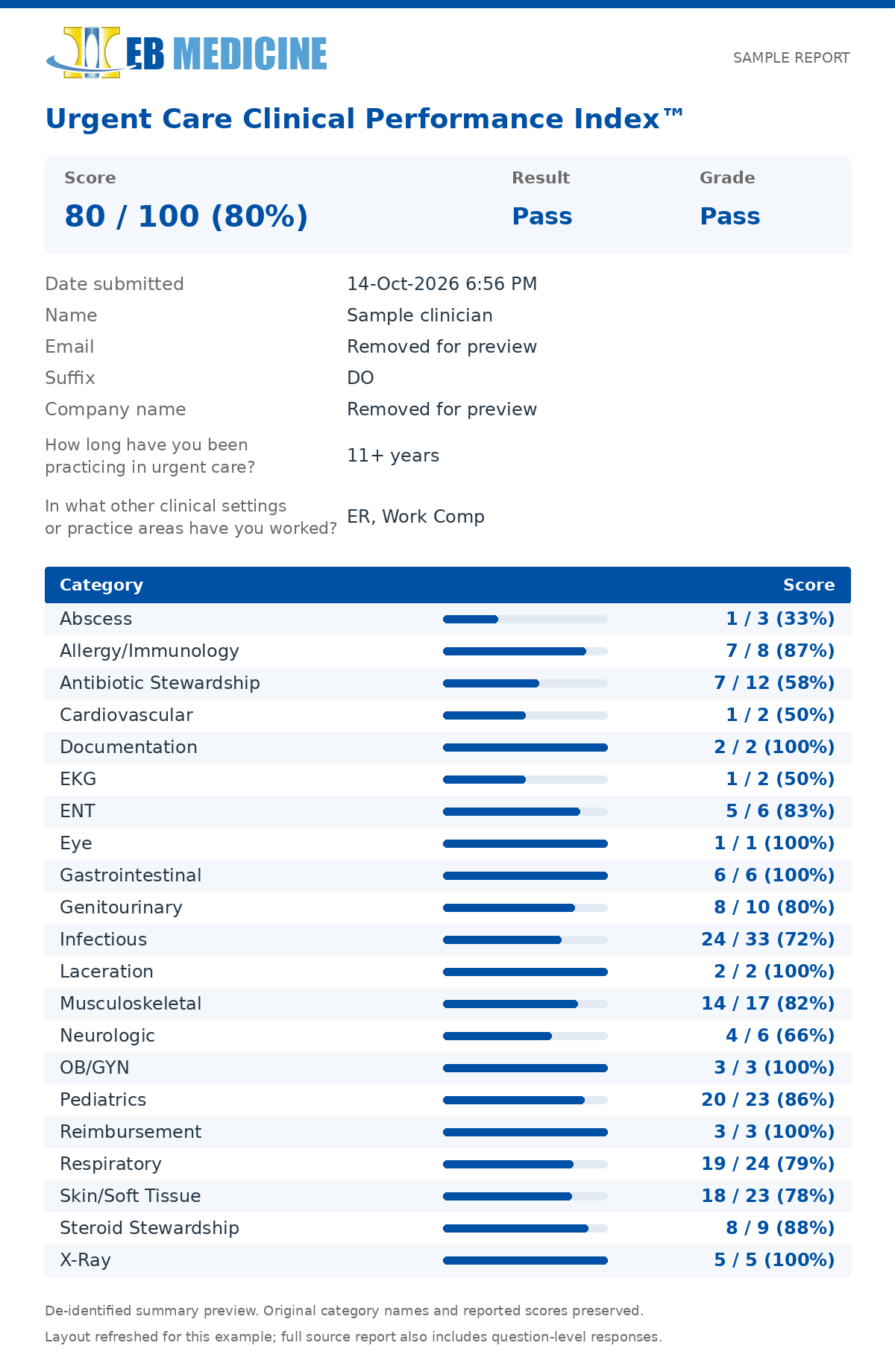
After submitting the assessment, clinicians see their score immediately and receive results by email, including the categories to focus on.
The accompanying CPI course mapping connects clinical categories to relevant EB Medicine courses and articles, helping leaders translate assessment findings into focused learning plans.
Identify priority areas for additional support.
Match those priorities with relevant education.
Guide onboarding, remediation, and professional development.
Review progress and adjust future training priorities.
Illustrative sample report. Results may be used to guide focused education.
Use the results throughout clinician development
One assessment. More informed training decisions.
01 / HIRING
Bring structure to hiring
Complement interviews and references with additional insight into clinical reasoning and learning needs.
02 / ONBOARDING
Make onboarding more targeted
Identify where new clinicians may benefit from focused training or supervision before independent shifts.
03 / DEVELOPMENT
Support continued development
Use results to guide education and future assessments, helping review progress over time.
What clinicians can expect
A straightforward path from insight to action.
1
Purchase the assessment
Purchase one Urgent Care Clinical Performance Index assessment for $250 through EB Medicine.
2
Complete 100 questions
Allow approximately two hours. The assessment includes a Save and continue option with a unique return link.
3
Review results and priorities
See the score after submission, review emailed results, and use the course mapping to select relevant education.
Who is the Clinical Performance Index designed for?
The CPI is developed around the clinical reasoning and operational realities of urgent care, including the kinds of presentations and decisions clinicians encounter on shift.
How long does it take, and can I pause?
Allow approximately two hours for the 100-question assessment. Within the assessment, select Save and continue, keep the unique return link, and use it to resume later.
What results will I receive?
The score appears immediately after submission. Results are also emailed to the clinician, including clinical categories to focus on. Those categories can be matched to relevant EB Medicine education.
Is this a course or a CME activity?
The CPI is an assessment of clinical decision-making, not a traditional educational course. Its purpose is to identify learning needs and guide targeted education.