
Thoracostomy and Thoracotomy for Emergency Management of Pediatric Pleural Space Pathologies
Click to check your cart0

Thoracostomy and Thoracotomy for Emergency Management of Pediatric Pleural Space Pathologies (Trauma CME)

Below is a free preview. Log in or subscribe for full access. Or, get a free sample article Evaluation and Management of Suicidal Ideation and Self-Harm in Children in the Emergency Department:

Get Your Sample Issue


Table of Contents
 

About This Issue

There are many pleural space diseases in pediatric patients that can present to the emergency department (ED). The ability to perform urgent interventions for life-threatening pleural space pathologies is essential for emergency clinicians. This issue reviews the clinical indications for thoracostomy and thoracotomy in pediatric patients, outlines procedural considerations, and discusses potential complications in the ED. In this issue, you will learn:

Guidance for prehospital care of patients with a suspected pleural space pathology, including indications for immediate needle thoracostomy, recommendations for pain management, and general considerations for transport

Possible physical examination findings for patients with pleural space pathologies

Which imaging study is the first-line modality for evaluating for pleural space pathology, and when computed tomography is indicated

Recommendations for management of pleural space pathologies in pediatric patients, including preprocedural preparation, pain management, and supportive care

Guidance for performing needle thoracostomy, chest tube thoracostomy, and pigtail catheter thoracostomy

Situations in which emergency resuscitative thoracotomy should be performed in the ED and recommendations for performing the procedure

Advancements in the field that reduce procedural delays and improve patient outcomes

Table of Contents
  1. About This Issue
  2. Abstract
  3. Case Presentations
  4. Introduction
  5. Critical Appraisal of the Literature
  6. Etiology and Pathophysiology
    1. Pneumothorax
    2. Pleural Effusions
    3. Effects of Impaired Gas Exchange
  7. Differential Diagnosis
    1. Pneumothorax
    2. Pleural Effusions
  8. Prehospital Care
    1. Decompression
    2. Pain Management
    3. Transport Considerations
  9. Emergency Department Evaluation
  10. Diagnostic Studies
    1. Chest X-Ray
    2. Ultrasound
    3. Computed Tomography
  11. Treatment
    1. Preprocedural Preparation
    2. Pain Management
    3. Supportive Care
    4. Thoracostomy
      1. Needle Thoracostomy
      2. Chest Tube Thoracostomy
      3. Pigtail Catheter Thoracostomy
    5. Thoracotomy
      1. Adult Studies
      2. Pediatric and Adolescent-Specific Studies
  12. Special Populations
    1. Obese Patients
    2. Patients With Secondary Pneumothorax
  13. Controversies and Cutting Edge
    1. Ultrasound for Pathology Diagnosis and Procedural Guidance
    2. Needle Placement During Decompression
    3. Needle Decompression and Chest Tube Placement Innovations
  14. Disposition
  15.  Summary
  16. Risk Management Pitfalls in the Emergency Department Management of Pediatric Patients With Pleural Space Pathologies
  17. 5 Things That Will Change Your Practice
  18. Time- and Cost-Effective Strategies
  19. Case Conclusions
  20. Clinical Pathway for Emergency Department Thoracotomy in Pediatric Patients With a Traumatic Plural Space Pathology
  21. Tables and Figures
  22. References

Abstract

While indications and techniques for thoracostomy are well-studied in adults, pediatric-specific evidence remains limited for emergency department-based thoracostomy and especially thoracotomy. The ability to perform urgent interventions for life-threatening pleural space pathologies is essential for all emergency clinicians. This issue reviews the clinical indications for thoracostomy and thoracotomy in pediatric patients, outlines procedural considerations for these techniques, and discusses potential complications in the emergency department. Advancements in the field are also highlighted, including emerging approaches to reduce procedural delays and improve patient outcomes.

Case Presentations

CASE 1
A 16-year-old boy is brought in via EMS after an all-terrain vehicle accident…
  • The boy was riding without a helmet when he lost control of his vehicle and hit a tree. He did not lose consciousness, but his chest hit the steering wheel. He has right-sided rib pain and shortness of breath.
  • On examination, he has right upper quadrant abdominal tenderness, diaphoresis, tachycardia, and tachypnea, with an oxygen saturation of 93% on room air.
  • You order a chest x-ray and begin to think about what interventions are needed…
CASE 2
A 16-year-old boy with increased work of breathing arrives via transfer from a different hospital…
  • The boy says he does not have an underlying cardiac or pulmonary history, and he has not been ill or had a fever recently.
  • His vital signs are stable. A chest x-ray from the referring hospital shows a moderately sized pneumothorax.
  • The pediatric surgical team is unable to come to the ED because they are scrubbed in on a surgical case. They ask if you could place a pigtail catheter if a repeat chest x-ray shows a pneumothorax of equal or larger size.
  • You try to remember the best location for insertion of a pigtail in this age group…
CASE 3
A 4-year-old girl who was involved in a shooting arrives to your community hospital…
  • The girl has a gunshot wound to her right torso. She is hemodynamically unstable, with respiratory distress and a respiratory rate in the 50s.
  • You activate the massive transfusion protocol and call the blood bank to have packed red blood cells on standby.
  • Your community hospital lacks the resources to definitively manage this patient, so you consider what stabilization is required prior to transfer…

How would you manage these patients? Subscribe for evidence-based best practices and to discover the outcomes.
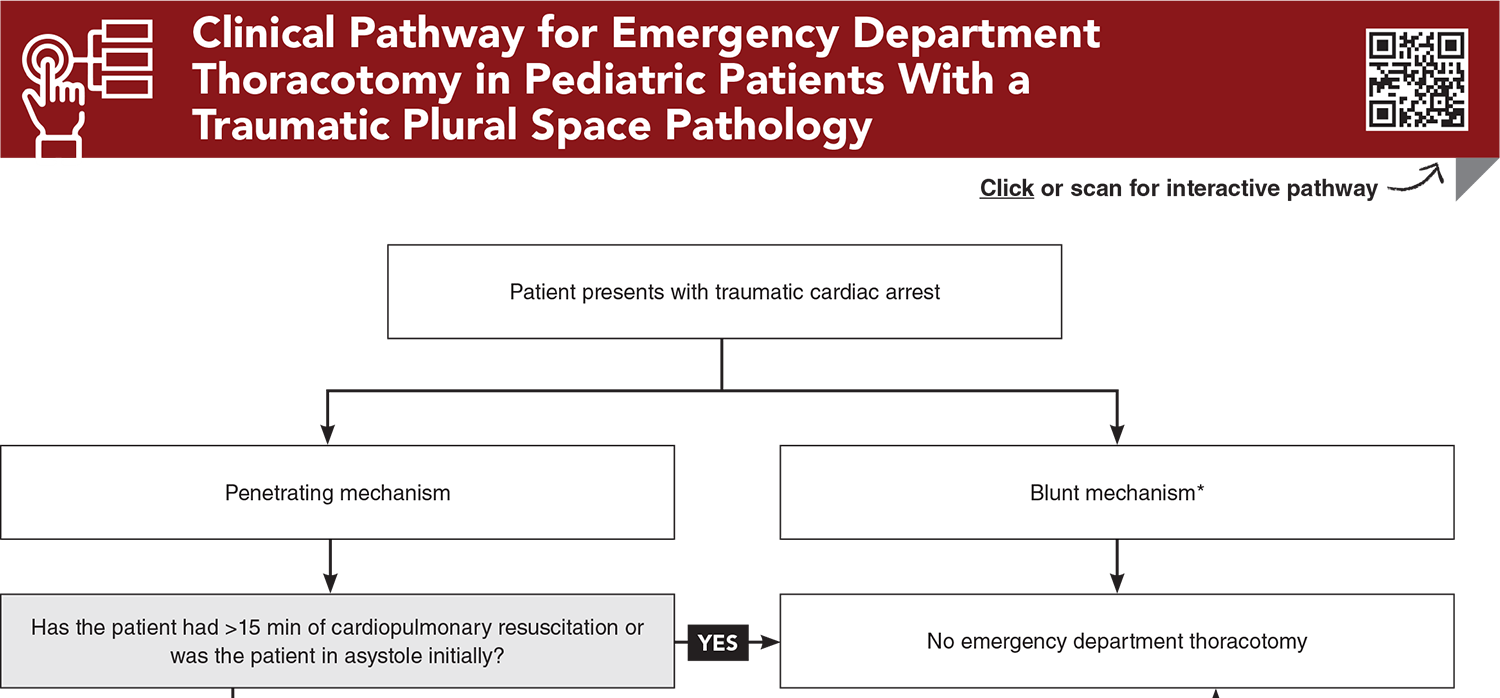
Clinical Pathway for Emergency Department Thoracotomy in Pediatric Patients With a Traumatic Plural Space Pathology

Clinical Pathway for Emergency Department Thoracotomy in Pediatric Patients With a Traumatic Plural Space Pathology

Subscribe to access the complete Clinical Pathway to guide your clinical decision making.

Tables and Figures

Table 1. Possible Physical Examination Findings in Patients With a Pleural Space Pathology

Subscribe for full access to all Tables and Figures.

Buy this issue and
CME test to get 4 CME credits.

Key References

Following are the most informative references cited in this paper, as determined by the authors.

2. * Feller-Kopman D, Light R. Pleural disease. N Engl J Med. 2018;378(18):1754. (Review) DOI: 10.1056/NEJMc1803858

4. * American College of Surgeons. Committee on Trauma. ATLS® : Advanced Trauma Life Support Student Course Manual. 11th ed. American College of Surgeons; 2025. (Book) ISBN: 9781880696521

55. * Selesner L, Yorkgitis B, Martin M, et al. Emergency department thoracotomy in children: a Pediatric Trauma Society, Western Trauma Association, and Eastern Association for the Surgery of Trauma systematic review and practice management guideline. J Trauma Acute Care Surg. 2023;95(3):432-441. (Systematic review; 319 patients) DOI: 10.1097/TA.0000000000003879

61. * Seamon MJ, Haut ER, Van Arendonk K, et al. An evidence-based approach to patient selection for emergency department thoracotomy: a practice management guideline from the Eastern Association for the Surgery of Trauma. J Trauma Acute Care Surg. 2015;79(1):159-173. (Review) DOI: 10.1097/TA.0000000000000648

63. * Moore HB, Moore EE, Bensard DD. Pediatric emergency department thoracotomy: a 40-year review. J Pediatr Surg. 2016;51(2):315-318. (Prospective cohort study; 179 patients) DOI: 10.1016/j.jpedsurg.2015.10.040

76. * Baumann MH, Strange C, Heffner JE, et al. Management of spontaneous pneumothorax: an American College of Chest Physicians Delphi consensus statement. Chest. 2001;119(2):590-602. (Review) DOI: 10.1378/chest.119.2.590

Subscribe to get the full list of 79 references and see how the authors distilled all of the evidence into a concise, clinically relevant, practical resource.

Keywords: thoracostomy, thoracotomy, pleural space pathology, pleural space pathologies, pneumothorax, spontaneous pneumothorax, primary pneumothorax, secondary pneumothorax, pleural effusion, empyema, hemothorax, chest x-ray, deep sulcus sign, ultrasound, barcode sign, atmosphere sign, lung point, computed tomography, needle decompression, needle thoracostomy, pigtail catheter, chest tube, transport considerations

Publication Information
Authors

Chantel Johnson, MD; James Dodington, MD

Peer Reviewed By

Ilene Claudius, MD; Kaitlyn Votta, MD

Publication Date

April 1, 2026

CME Expiration Date

April 1, 2029    CME Information

CME Credits

4 AMA PRA Category 1 Credits™, 4 ACEP Category I Credits, 4 AAP Prescribed Credits, 4 AOA Category 2-B Credits.
Specialty CME Credits: Included as part of the 4 credits, this CME activity is eligible for 4 Trauma CME credits, subject to your state and institutional approval.

Pub Med ID: 41861350

Get Permission

Content you might be interested in
Get A Sample Issue Of Emergency Medicine Practice
Enter your email to get your copy today! Plus receive updates on EB Medicine every month.
Verification Word:
Enter Verification Word: