
Constipation in Urgent Care
Click to check your cart0

Urgent Care Evaluation and Management of Constipation

Below is a free preview. Log in or subscribe for full access. Or, get a free sample issue of Evidence-Based Urgent Care:
Get Your Sample Issue

Table of Contents
 

About This Issue

Constipation is a common, and distressing, presentation in urgent care. While it is usually benign and can be managed in the urgent care setting, occasionally constipation can indicate or lead to serious, life-threatening conditions such as fecal impaction and stercoral colitis. This issue of Evidence-Based Urgent Care emphasizes that constipation is a diagnosis of exclusion based on a focused history and physical examination to rule out emergent conditions and identify red-flag symptoms. The Bristol Stool Form Scale, clinical criteria, and digital rectal examination may play a key diagnostic role. Management should be tailored to the likely etiology of constipation, with most stable patients safely discharged on a bowel regimen and appropriate follow-up. In this issue, you will learn:

How to evaluate a presentation of constipation, including how to recognize dangerous etiologies and complications and how to perform a digital rectal examination;

Which treatments for constipation are appropriate for various underlying etiologies, comorbid medical conditions, and in concert with other medications; and

When and how to identify patients who may benefit from specialist or emergency department referral for consideration of advanced diagnostic and therapeutic options.

CODING & CHARTING: Support the level of care provided and appropriate billing for patients presenting with constipation in the urgent care setting with proper documentation. Learn more in our monthly coding column.

Table of Contents
  1. About This Issue
  2. *Acknowledgement
  3. Abstract
  4. Case Presentations
  5. Introduction
  6. Etiology and Pathophysiology
  7. Differential Diagnosis
    1. Fecal Impaction
    2. Stercoral Colitis
    3. Other Potentially Dangerous Causes of Constipation
  8. Urgent Care Evaluation
    1. History
    2. Physical Examination
  9. Diagnostic Studies
    1. Abdominal Radiographs
    2. Advanced Testing
  10. Treatment
    1. Treatment of Fecal Impaction
    2. Treatment of Stercoral Colitis
    3. Enemas
    4. Osmotic Laxatives
      1. Polyethylene Glycol
      2. Lactulose
      3. Magnesium
    5. Stimulant Laxatives
    6. Fiber Supplementation
  11. Disposition
  12. Special Populations
    1. Pregnant and Lactating Patients
    2. Patients on Hospice or at End of Life
    3. Patients Taking Glucagon-like Peptide-1 Receptor Agonists
  13. Controversies and Cutting Edge
    1. Intestinal Secretagogues
    2. Treatment of Opioid-Induced Constipation
    3. Relationship of the Gut Microbiome to Constipation
  14. Summary
  15. Time- and Cost-Effective Strategies
  16. 5 Things That Will Change Your Practice
  17. Risk Management Pitfalls for Managing Urgent Care Patients With Constipation
  18. Critical Appraisal of the Literature
  19. KidBits: Functional Constipation in Children
    1. Urgent Care Evaluation
    2. Treatment
    3. Conclusion
    4. References
  20. Case Conclusions
  21. Coding & Charting: What You Need to Know
  22. Coding Challenge: Presentation of Constipation in Urgent Care
  23. Clinical Pathway for Management of Urgent Care Patients With Constipation
  24. References

*Acknowledgement

Portions of this content were previously published in: Richardson C. Emergency department evaluation and management of constipation. Emerg Med Pract. 2024;26(3):1-24. Used with permission of EB Medicine.

Abstract

Most cases of constipation are benign, but serious complications, such as fecal impaction and stercoral colitis, can occur. Data about how often patients present to urgent care with this complaint, as well as evidence to guide the evaluation and treatment of these patients, are limited. Many of the decades-old treatments have not been studied in modern, rigorous, controlled trials. Constipation is a clinical diagnosis, but one of exclusion, and ideal management includes evaluation for dangerous mimics or complications and, for most patients, discharging the patient with a bowel regimen tailored to the likely cause of their constipation, with appropriate referral to primary or specialty care. This review evaluates consensus guidelines on management of constipation as well as the early data on the newer prescription medications for chronic and opioid-induced constipation.

Case Presentations

CASE 1
An 85-year-old woman is brought into urgent care by her son who is worried she may “have another UTI”…
  • The patient has a history of diabetes, stroke, and mild dementia.
  • The patient’s son reports that she is usually alert and oriented to person and place, but today she seems weak and confused and is barely talking.
  • She hasn’t had a bowel movement in 5 days, even after getting an enema yesterday.
  • On examination, she is tachycardic with a nontender but mildly distended abdomen. Her vital signs are: temperature, 37.3°C; heart rate, 114 beats/min; blood pressure, 104/58 mm Hg; and oxygen saturation, 94% on room air.
  • You wonder whether an episode of simple constipation could make someone this sick…
CASE 2
A 28-year-old woman who is 30 weeks pregnant presents to urgent care with decreased bowel movements and moderate crampy and sometimes sharp lower abdominal discomfort for several hours...
  • The patient says she has “not had a decent BM” in weeks, and the pain started as she strained, unsuccessfully, to have a bowel movement.
  • She notes that she is taking oral iron supplementation for anemia, which got worse with her pregnancy.
  • She is slightly tachycardic but afebrile, with otherwise normal vital signs. Her examination shows moderate tenderness in the right mid- and lower abdomen.
  • You wonder if this is a simple case of constipation related to iron supplementation or whether the patient requires imaging….
CASE 3
The parents of a 7-year-old boy bring him to urgent care after several hours of intermittent crampy lower abdominal pain...
  • He has had no fever, nausea, or vomiting. They note that about a year prior, he had similar pain and that an enema given in his pediatrician’s office alleviated the problem, but his pediatrician is not available today.
  • His vital signs are normal, and his examination reveals only minimal left lower abdominal tenderness. Genital examination is normal with nontender testes.
  • You wonder if an x-ray is needed to confirm the diagnosis and whether an enema is reasonable to give in this case...

How would you manage these patients? Subscribe for evidence-based best practices and to discover the outcomes.
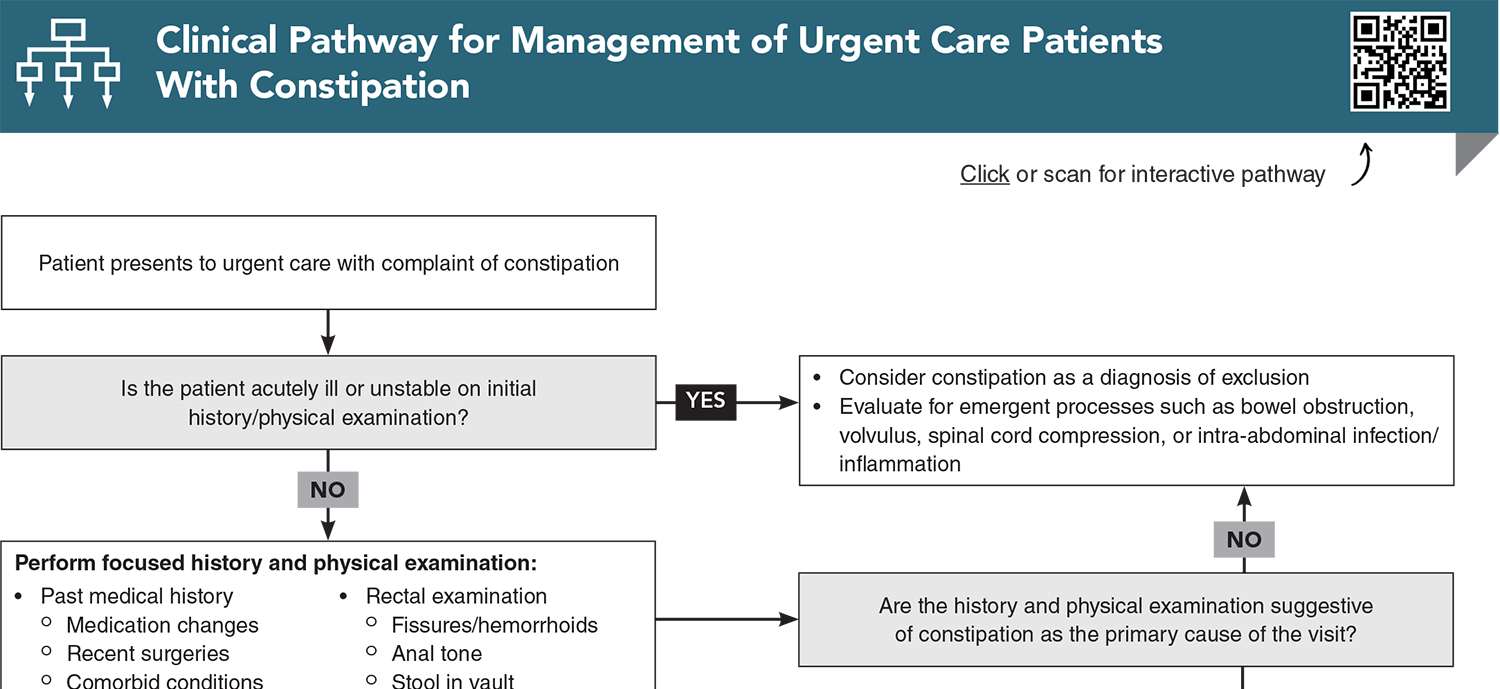
Clinical Pathway for Management of Urgent Care Patients With Constipation

Clinical Pathway for Management of Urgent Care Patients With Constipation

Subscribe to access the complete Clinical Pathway to guide your clinical decision making.

Buy this issue and
CME test to get 4 CME credits.

Key References

Following are the most informative references cited in this paper, as determined by the authors.

1. * Chang L, Chey WD, Imdad A, et al. American Gastroenterological Association-American College of Gastroenterology clinical practice guideline: pharmacological management of chronic idiopathic constipation. Am J Gastroenterol. 2023;164(7):1086-1106. (Guidelines) DOI: 10.14309/ajg.0000000000002227

7. * Zhou AZ, Lorenz D, Simon NJ, et al. Emergency department diagnosis and management of constipation in the United States, 2006-2017. Am J Emerg Med. 2022;54:91-96. (Cross-sectional study) DOI: 10.1016/j.ajem.2022.01.065

14. * Bharucha AE, Lacy BE. Mechanisms, evaluation, and management of chronic constipation. Gastroenterology. 2020;158(5):1232-1249. (Review) DOI: 10.1053/j.gastro.2019.12.034

19. * Rao SSC, Brenner DM. Efficacy and safety of over-the-counter therapies for chronic constipation: an updated systematic review. Am J Gastroenterol. 2021;116(6):1156-1181. (Systematic review; 41 studies) DOI: 10.14309/ajg.0000000000001222

26. * Keim AA, Campbell RL, Mullan AF, et al. Stercoral colitis in the emergency department: a retrospective review of presentation, management, and outcomes. Ann Emerg Med. 2023;82(1):37-46. (Retrospective study; 269 patients) DOI: 10.1016/j.annemergmed.2023.02.003

30. * Paquette IM, Varma M, Ternent C, et al. The American Society of Colon and Rectal Surgeons’ clinical practice guideline for the evaluation and management of constipation. Dis Colon Rectum. 2016;59(6):479-492. (Guideline) DOI: 10.1097/DCR.0000000000000599

38. * Peate I. How to perform digital removal of faeces. Nurs Stand. 2016;30(40):36-39. (Review) DOI: 10.7748/ns.30.40.36.s43

64. * Farmer AD, Drewes AM, Chiarioni G, et al. Pathophysiology and management of opioid-induced constipation: European expert consensus statement. United European Gastroenterol J. 2019;7(1):7-20. (Guideline) DOI: 10.1177/2050640618818305

69. * Hanson B, Siddique SM, Scarlett Y, et al. American Gastroenterological Association Institute technical review on the medical management of opioid-induced constipation. Gastroenterology. 2019;156(1):229-253. (Systematic review; 20 studies) DOI: 10.1053/j.gastro.2018.08.018

Subscribe to get the full list of 72 references and see how the authors distilled all of the evidence into a concise, clinically relevant, practical resource.

Keywords: constipation, large intestine, stool, feces, gastrointestinal, colonic transit, fecal impaction, stercoral colitis, functional constipation, irritable bowel syndrome with constipation, opioid-induced constipation, occasional constipation, defecatory disorder, abdominal radiograph, digital rectal examination, Bristol Stool Form Scale, Rome Foundation diagnostic criteria, abdominal pain, bowel obstruction, osmotic laxatives, stimulant laxatives, stool softeners, bowel regimen, hemorrhoids, polyethylene glycol (PEG), bisacodyl, senna, enema, digital disimpaction, fiber, psyllium, lactulose, magnesium laxatives, intestinal secretagogues, peripherally acting mu-opioid receptor antagonists

Publication Information
Author

Joseph Toscano, MD

Peer Reviewed By

Sean M. McNeeley, MD, FCUCM

Publication Date

February 1, 2026

CME Expiration Date

February 1, 2029    CME Information

Get Permission

Get A Sample Issue Of Emergency Medicine Practice
Enter your email to get your copy today! Plus receive updates on EB Medicine every month.
Verification Word:
Enter Verification Word: