Online CME Course for Emergency Medicine and Urgent Care Clinicians
The Laceration Course
You learned to throw a stitch.
Nobody taught you the rest.
The full encounter: Evaluation, anesthesia, irrigation, closure, aftercare, charting, coding, and medicolegal riskTwelve focused modules, 8 CME credits, and a Suture Practice Kit shipped to you, so you can manage the full encounter on your very next shift
8 CME credits Free Suture Practice KitSelf-paced, with audio versions of every module
Free Suture
Practice Kit
Included
12Focused modules
8CME credits
OnlineLearn at your pace
$299Individual access
Master the Full Laceration Encounter
A good stitch is the easy part
Strong outcomes depend on the decisions around the stitch: how you evaluate the wound, which anesthetic you choose and how much irrigation you use, which closure method you select, and which injuries need referral. What you tell the patient at discharge and what you put in the chart matter, too.
The Laceration Course gives you a practical framework for the whole encounter, from the first question in the history to the final code on the claim.
The common gap
Most clinicians were taught a few stitches.
Not the decisions around them.
In a survey of nurse practitioners, 73% said their graduate program did not provide adequate didactic and hands-on training in suturing and laceration management. That is a training gap, not a character flaw. It shows up as hesitation on complex locations, uncertainty about closure choices, and charts that do not tell the full story.
The course approach
Best practices for the full encounter
Learn how to evaluate wounds systematically, prepare for repair, choose the right materials and technique, and manage special presentations involving fingers, faces, bites, punctures, skin tears, and more.
Step-by-step animations, cadaver demonstrations, 20 case studies, and hands-on practice with your Suture Practice Kit turn knowledge into technique.
Built for immediate clinical impact
How this course will change your practice
01
Choose the right repair, not just the familiar one.
Weigh wound and patient factors, compare closure options, and match technique and materials to the wound.
02
Practice before the patient is in front of you.
Watch each technique step by step, then repeat it on your own practice pad until it feels routine.
03
Finish the encounter, not just the procedure.
Aftercare, discharge instructions, documentation, coding, and medicolegal risk are each taught as part of the repair.
Designed for the way you learn
Learn, watch, practice, and apply
Learn at your own pace. Reinforce each lesson with the interactive workbook
and hands-on practice with your Suture Practice Kit.
Interactive
Workbook
See techniques step by step. Animated videos and cadaver demonstrations make wound-closure methods easier to understand and repeat.
Apply the lessons to real cases. Twenty case studies help you connect course principles with the presentations you encounter in practice.
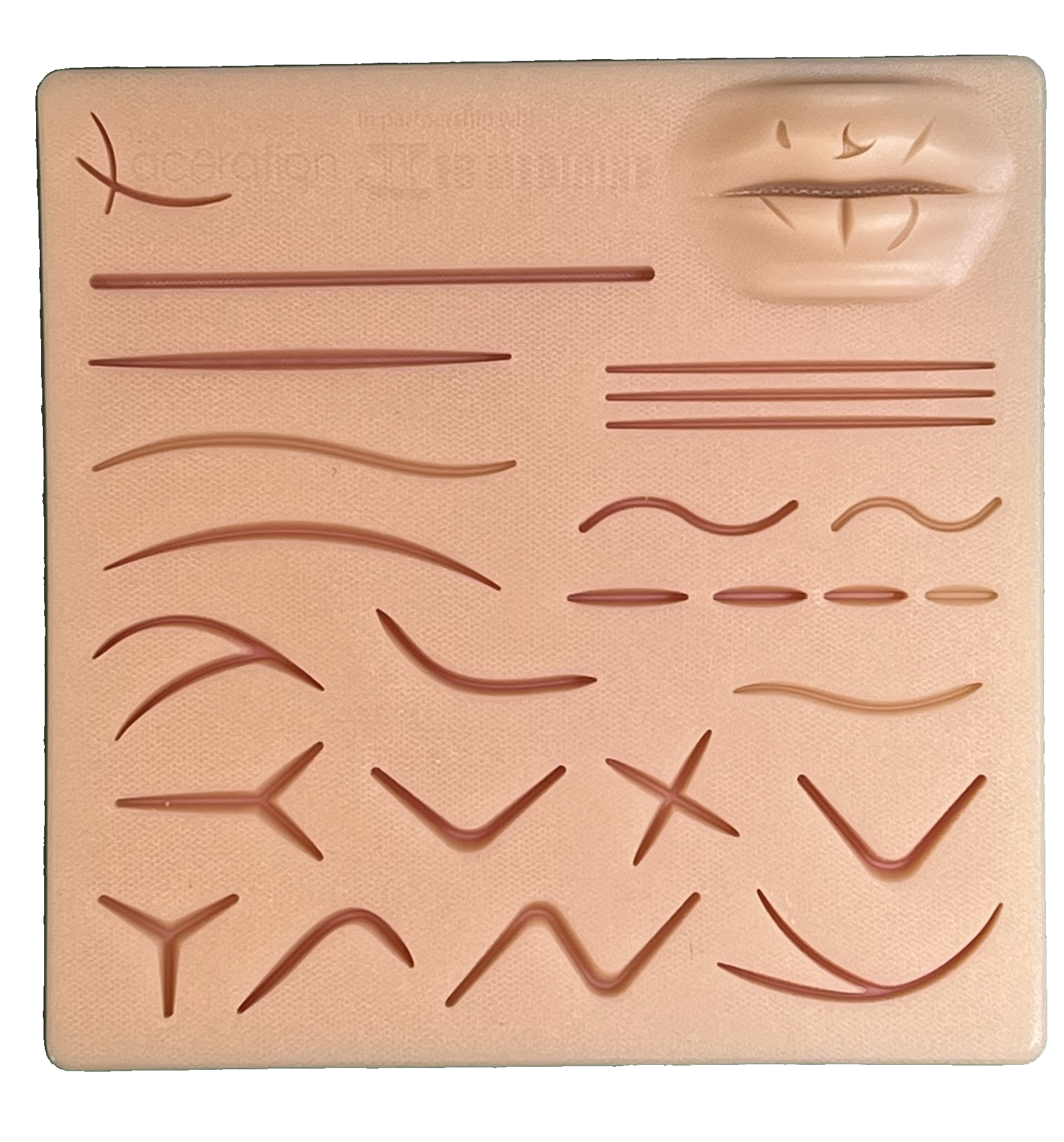
Build skill with your own hands. Your free Suture Practice Kit is shipped after enrollment and includes instruments, suture material, and a custom silicone pad with simulated 3D lips for vermilion-border repairs and complex simulated lacerations.
From fundamentals to real-world application
Explore the course modules
01Evaluate and Prepare 3 modules +
Module 1: Background & Basics
The 4 phases of wound healing, host and wound factors, and the structured history and exam that guide every closure decision
Module 2: Preparing for Repair
Wound evaluation, choosing an anesthetic (including buffered lidocaine and alternatives to injection), and irrigation that reduces infection risk
Module 3: Supplies & Setup
What to stock, where to store it, and how procedure mapping and ergonomics save time on every repair
02Repair 5 modules +
Module 4: Essential Repair Skills
Minimizing tension, ensuring eversion, and matching the closure to the wound, with step-by-step demos of sutures, staples, adhesives, and novel closure devices, from simple running to subcuticular
Module 5: Repairing Fingers
How to evaluate and repair most finger injuries, and which presentations need immediate referral
Module 6: Repairing Faces
Facial nerve blocks, eyelid and eyebrow lacerations, intraoral wounds, and how to avoid a misaligned vermilion border
Antibiotic prophylaxis, home care, red flags, discharge instructions, and suture removal
03Protect Your Practice 4 modules +
Module 9: Mitigating Risk
The 3 biggest risks for complications and malpractice claims in laceration care, with emergency physician and attorney Dr. William Sullivan joining Dr. O’Malley
Module 10: Safeguarding Charting
The documentation dos and don’ts that support and defend your medical decision-making
Module 11: Rightsizing Reimbursement
How documentation drives coding, how to distinguish simple, intermediate, and complex repairs, and how to avoid undercoding that leaves revenue on the table or overcoding that invites audits
Module 12: Case Presentations
Six cases that bring every module together
Choose how you learn best
More than one way to learn and practice
▶
Video modules
Focused instruction covering the clinical knowledge and practical decisions behind laceration care.
✓
Technique demonstrations
Step-by-step animations and cadaver demonstrations for stitches and closure methods.
Real-world cases
Twenty case studies that reinforce evaluation, repair, aftercare, and risk management.
✎
Interactive workbook
A downloadable companion resource that helps you engage with and retain the lessons.
♪
Audio-only lessons
Listen to every module while commuting or whenever audio fits your schedule best.
Earn credit as you go.
CME tests and credit hours are available for each module.
The proof is in the practice
What clinicians say about the course
Here’s what your peers have to say about The Laceration Course.
“
Excellent course, well organized. Helpful even for more advanced practitioners.
Meghan Shorter, MD
“
This was a very informative course and thoroughly prepared. I feel much more confident about suturing as a new NP because of this course. Thank you so much!
Elise Roberts, NP
“
I would recommend The Laceration Course to all new and experienced providers in urgent care and emergency department settings. The course discussed many great suturing pearls that I found to be very helpful.
Gillian Melikian, PA
Turn knowledge into confident care
Be ready for the next wound that walks in
Enroll today to build a practical, evidence-based approach to laceration care—with 12 modules, 20 case studies, flexible learning resources, and a free Suture Practice Kit.
Practical expertise from the front lines
Learn from experienced clinical faculty
The faculty bring more than two decades of frontline emergency and urgent care experience, deep practical expertise in laceration evaluation and repair, and specialized medicolegal guidance—grounding every lesson in the full clinical encounter.
Patrick O’Malley, MD
Emergency physician, educator, and creator of The Laceration Course
Read full bio
Dr. Patrick O’Malley is an emergency physician and educator with more than 20 years of experience in emergency and urgent care settings. He earned his medical degree from the Brody School of Medicine at East Carolina University and completed his residency at Carolinas Medical Center in Charlotte, North Carolina. He created The Laceration Course and The Abscess Course, which are used by urgent care centers, emergency departments, and residency programs across the country. He has presented at national conferences and serves as a peer reviewer for Evidence-Based Urgent Care.
William P. Sullivan, DO, JD
Emergency physician, attorney, and medicolegal educator
Read full bio
Dr. William P. Sullivan is a practicing emergency medicine physician and experienced attorney. He is a Clinical Assistant Professor in the Department of Emergency Medicine at Midwestern University in Downers Grove, Illinois, and maintains an active legal practice. He has served as Senior Editor for Emergency Physician’s Monthly since 2014 and regularly writes and speaks on medicolegal topics.
Accredited continuing medical education
CME and accreditation
Earn credit while strengthening the laceration-management skills you use in emergency and urgent care practice.
8AMA PRA Category 1 Credits™8 AOA Category 2-B credit hours
Accreditation: EB Medicine is accredited by the Accreditation Council for Continuing Medical Education (ACCME) to provide continuing medical education for physicians.
AMA Credit Designation: EB Medicine designates this enduring material for a maximum of 8 AMA PRA Category 1 Credits™. Physicians should claim only the credit commensurate with the extent of their participation in the activity.
AOA Credit Designation:The Laceration Course is eligible for 8 Category 2-B credit hours by the American Osteopathic Association.
Everything you need to know
Questions before enrolling?
Find quick answers about course content, included resources, CME, and group enrollment.
Who is this course for? +
The course is designed for new and experienced emergency medicine and urgent care clinicians—including physicians, PAs, NPs, nurses, residents, and others who want to strengthen their knowledge and skills in laceration management.
What does the Suture Practice Kit include?+
Your free kit includes a custom-designed silicone practice pad, instruments, and suture material. The pad includes simulated 3D lips for practicing vermilion border repairs as well as complex simulated lacerations.
What learning resources are included? +
You’ll receive 12 online video modules, step-by-step animations and cadaver demonstrations, 20 case studies, a downloadable interactive workbook, and audio-only versions of every module.
How long does the course take?+
The course offers 8 CME credits and is fully self-paced, with credit available as you go.
Is group pricing available? +
Yes. Special pricing is available for emergency medicine and urgent care groups.
Build knowledge. Build skills. Build confidence.
Ready to manage lacerations with greater confidence?
 678-366-7933


 Store