Hidden Costs of Undertraining | EB Medicine
Click to check your cart0

The Five Hidden Costs of Undertraining

You know what training costs.
What is undertraining costing you?

Revenue that leaves with avoidable transfers. Capacity lost to clinical uncertainty. The cost of rebuilding an experienced team. See where clinical capability may be influencing your financial performance—and how to evaluate the opportunity.

Watch the presentation, then take a closer look at your clinics’ priorities. Schedule a 30-minute session and receive the interactive whitepaper in your inbox.

Watch the video

The Five Hidden Costs of Undertraining

A Framework for Quantifying the Enterprise Cost of Clinical Capability Gaps

Presented by Patrick O’Malley, MD
Emergency Medicine and Urgent Care Physician • EB Medicine Course Director

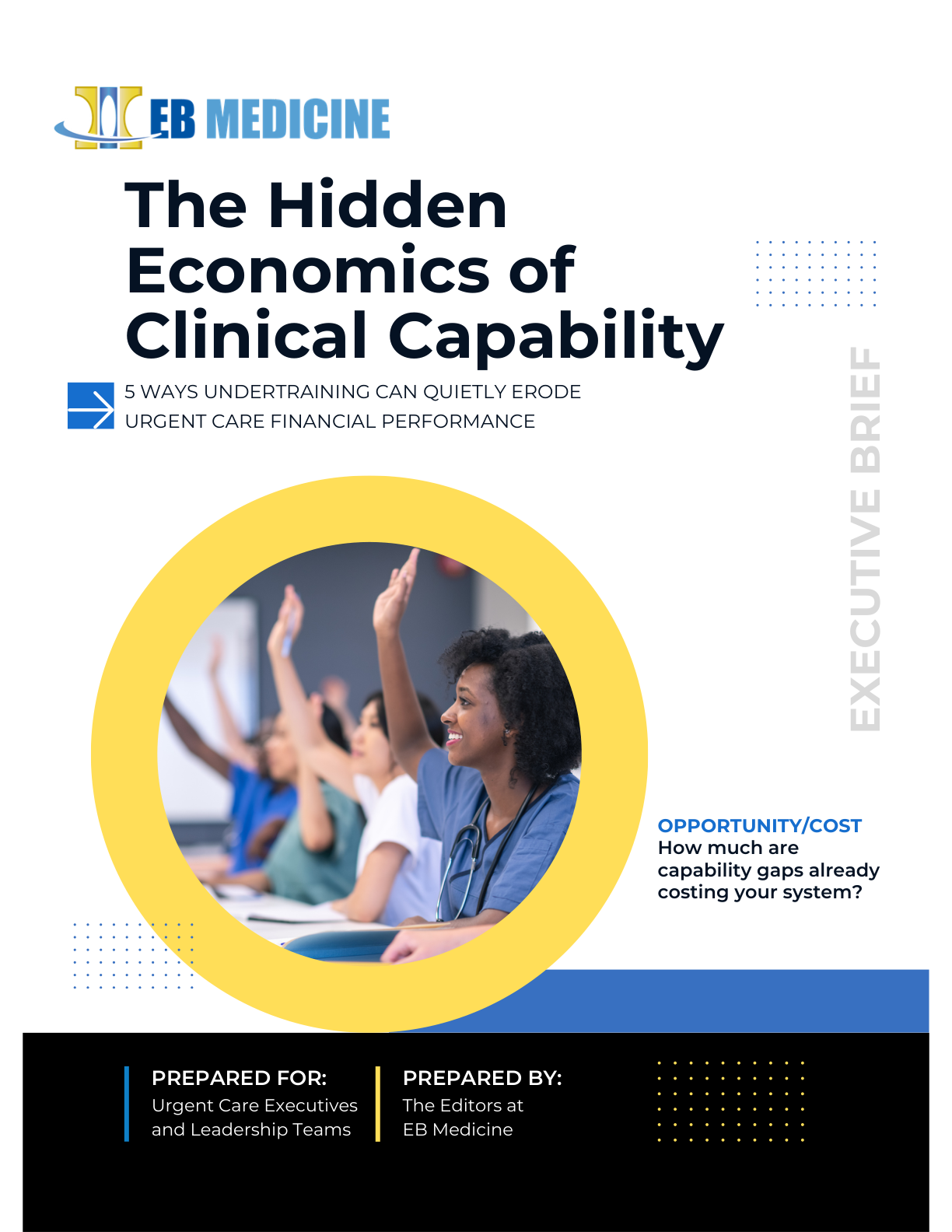
The Hidden Economics of Clinical Capability: 5 Ways Undertraining Can Quietly Erode Urgent Care Financial Performance — whitepaper cover

Included with your complimentary session

A closer look at your clinics. A resource to keep the work moving.

Schedule your Clinical Capability Strategy Session and receive The Hidden Economics of Clinical Capability: 5 Ways Undertraining Can Quietly Erode Urgent Care Financial Performance in your inbox. Its interactive worksheets help you explore potential revenue opportunities, operating costs, and the impact of clinical capability gaps across your clinics.

  • Estimate revenue and capacity opportunities with worksheets for retained visits, procedural revenue, and recoverable time.
  • Make replacement costs visible by accounting for recruiting, coverage, onboarding, and productivity ramp-up.
  • Audit experience and risk with a brand/capability review and risk/capability crosswalk.
  • Build a measurable business case with a baseline KPI roadmap, investment calculator, and projected ROI framework.
Schedule your session & receive the whitepaper

Your complimentary interactive whitepaper will be delivered to your inbox when you schedule your session.

The financial impact of clinical capability

Clinical capability is an operating asset.

Training costs appear in your budget. The costs of capability gaps can be harder to identify, spread across lost revenue, slower patient flow, and workforce replacement. This framework helps you connect those costs to the performance measures your organization already tracks.

Five costs that affect financial performance

Where could capability gaps be affecting your performance?

Start with the measures your leadership team already monitors. Then investigate where clinical readiness, proficiency, or consistency may be part of the equation.

01

Avoidable transfers

When patients leave for care your centers are equipped to provide, existing demand can become lost visit and procedural revenue.

Revenue retentionEvaluate potentially avoidable transfers, retained visits, procedure completion, and net revenue per visit.

02

Time lost to clinical uncertainty

Repeated consultation, procedural hesitation, and delayed decisions can consume clinician time and limit the number of patients your team can see.

Throughput & capacityExamine encounter duration, patients per clinician-hour, backup interruptions, and capacity you can realistically convert to visits.

03

Burnout & turnover

A departure costs more than recruiting. Coverage, onboarding, mentor time, and the ramp to proficiency all belong in the calculation.

Workforce economicsEstimate replacement cost, annual departures, and time to independent proficiency.

04

Brand erosion

Clinical execution shapes whether patients receive the experience you promised—and whether they return or recommend you.

Patient experience & future demandReview complaints, ratings, and experience themes for possible capability contributors.

05

Risk exposure

Readiness gaps can surface in diagnostic decisions, procedures, escalation, and documentation—well beyond the training budget.

Enterprise riskConnect incidents, near misses, and claims patterns to training coverage and competency assessment.

Clinical Capability Strategy Session • 30 minutes

Which opportunity deserves a closer look in your organization?

Explore what the five hidden costs could mean for your clinics in a focused conversation with the EB Medicine team. Choose the topics most valuable to you, and we’ll use the relevant whitepaper worksheets to guide the conversation around your priorities.

  1. Start with your performance priorities.Discuss where transfers, throughput, turnover, patient experience, or risk are creating concern.
  2. Identify a useful starting point.Consider which capability gap, clinician cohort, and baseline KPI would be most useful to examine.
  3. Explore a measurable next step.Discuss where targeted education may fit and how your team could evaluate its value.

Schedule your session. Receive your whitepaper.
Complete the form to schedule your complimentary 30-minute session and select the hidden cost topics most valuable to you. The interactive whitepaper will be delivered to your inbox when you schedule, so you can review it before we meet. No completed worksheets or advance data gathering are required.

Fill out my online form.

Your complimentary interactive whitepaper will arrive by email when you schedule your session.

Before you begin

A few practical details.

How do I get the whitepaper?

Schedule your complimentary 30-minute Clinical Capability Strategy Session using the form above. The interactive whitepaper, The Hidden Economics of Clinical Capability, will be delivered to your inbox when you schedule, so you can review it before your session.

Is this relevant to my role?

Urgent care executives and leaders responsible for financial performance, operations, clinical education, or enterprise purchasing—including teams evaluating education across multiple locations.

How does the Clinical Capability Strategy Session relate to the whitepaper?

You’ll receive the whitepaper by email when you schedule your session. It introduces five hidden costs of undertraining and worksheets for exploring their potential impact. During your complimentary 30-minute session, we’ll use the worksheets relevant to the topics you select to discuss what those costs could mean for your clinics and identify a useful starting point. You don’t need to complete the worksheets or gather data beforehand.

Do I need to prepare data before the session?

You can start with your priorities and the questions you want to answer. If available, transfer patterns, net revenue per visit, throughput measures, turnover costs, or onboarding timelines can help make the discussion more specific.

Does the framework promise a financial return from training?

It helps you evaluate training as a performance investment: establish your baseline, estimate potential value, define the investment, and measure what changes. Your organization’s results provide the basis for assessing ROI.

Schedule your session & receive the whitepaper